AP Physics C Score Calculator: Mechanics Points to a 1–5
Academic examsEstimate an AP Physics C: Mechanics composite from multiple-choice and free-response points.
Score thresholds
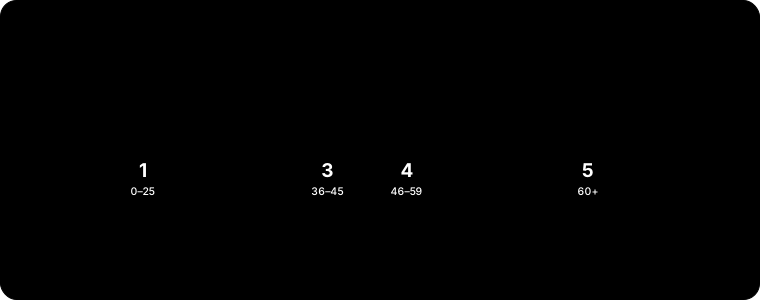
Editable estimated composite cutoffs. Official AP raw-score cutoffs are not published and can shift by exam year.
The AP Physics C score calculator above turns your Mechanics raw scores into a predicted 1–5 in seconds: enter your multiple-choice total (out of 40) and your free-response points (out of 40 across four questions), and the tool builds a weighted composite out of 100 and maps it to an AP score. Below the calculator you will find the exact formula it uses, the estimated composite cutoffs (a 5 starts near 60 — unusually generous, because this exam is unusually hard), the 2026 score distribution, and what the coming format change to 42 questions means for you.
How the AP Physics C Mechanics Score Calculator Works
The calculator mirrors the exam's two halves. You enter your Section I raw score — the number of multiple-choice questions you answered correctly, out of 40 — and your Section II raw score, the free-response points you earned out of 40. There is no guessing penalty on AP exams, so your multiple-choice raw score is simply your number of correct answers. The tool normalizes each section to 50 points, adds them into a composite score out of 100, and compares that composite against the 1–5 cutoff bands shown further down this page.
Because AP Physics C: Mechanics is a calculus-based exam, its raw scores look nothing like what students expect from an algebra-based class. Under the cutoffs this tool ships with, answering just 24 of the 40 multiple-choice questions correctly — missing 16 of them — still leaves a 5 in reach, provided you pair it with 24 of the 40 free-response points. A threshold that forgiving is rare across the AP program. That is exactly why using an AP Physics Mechanics score calculator built on Physics C cutoffs matters: drop a Physics C raw score into an AP Chemistry or AP Physics 1 predictor and it will badly underrate you.
Every cutoff in the tool is editable. If your teacher shares a curve from a released exam, or you simply want to stress-test a pessimistic scenario, change the thresholds and the predicted score updates instantly. The 50/50 section weighting is fixed because the College Board publishes it; only the composite-to-1–5 mapping is an estimate, and we would rather hand you the dial than pretend otherwise.

| Question | Section | Max | Weight |
|---|---|---|---|
| Multiple Choice Correct | Multiple Choice | 40 | |
| Q1: Mathematical Routines | Free Response | 10 | |
| Q2: Translation Between Representations | Free Response | 12 | |
| Q3: Experimental Design and Analysis | Free Response | 10 | |
| Q4: Qualitative/Quantitative Translation | Free Response | 8 |
Inputs: your multiple-choice raw score (0–40) and your free-response points (0–40, summed across Q1 = 10 pts, Q2 = 12 pts, Q3 = 10 pts, Q4 = 8 pts). Outputs: a weighted composite score out of 100 and a predicted AP score of 1–5. Because both sections carry 40 raw points and equal weight, one multiple-choice point and one free-response point are each worth exactly 1.25 composite points — so spend your remaining prep time on whichever section you can improve fastest.
- Score your multiple choice out of 40. Count correct answers only — blanks and wrong answers cost the same, so never leave a bubble empty.
- Score your free response using the official rubric, question by question: Q1 out of 10, Q2 out of 12, Q3 out of 10, Q4 out of 8. Add them for a total out of 40.
- Enter both raw scores. The composite updates live, and the predicted 1–5 appears alongside it.
- Adjust the cutoffs if you have a better source, then re-run the numbers with a target in mind to see how many points separate you from the next band.
How the AP Physics C: Mechanics Exam Is Scored
AP Physics C: Mechanics is a standalone exam with a standalone 1–5 score. It is not a section of a larger physics test — students who also sit AP Physics C: Electricity and Magnetism receive a completely separate score for that exam, and the two are commonly scheduled on the same day. Both are calculus-based, which is the fundamental divide between them and the algebra-based AP Physics 1 exam. If you are deciding which predictor to use, the rule is simple: if your exam required derivatives and integrals, you want this page.
For the May 2025 and May 2026 administrations, Section I is 40 multiple-choice questions in 80 minutes, worth 50% of your score. Section II is 4 free-response questions in 100 minutes, also worth 50%, handwritten on paper and worth 40 raw points in total. Per the official 2025 scoring guidelines the four question types are Mathematical Routines (10 points), Translation Between Representations (12 points), Experimental Design and Analysis (10 points), and Qualitative/Quantitative Translation (8 points). A graphing calculator is permitted on both sections and a formula sheet is provided — you can confirm the current specifications on the College Board's AP Physics C: Mechanics exam page.
One format note that trips people up in 2026 and 2027: AP Central and AP Students now publish 42 multiple-choice questions in 85 minutes and a 95-minute free-response section effective with the May 2027 administration. This calculator deliberately uses the 40-question format, because that is what every released practice exam is built on and what the 2026 cohort — whose score distribution we show below — actually sat. Total exam length is unchanged at 180 minutes, and Section II remains 4 free-response questions carrying 50% of the score.
| Section | Questions | Time | Weight | Raw points |
|---|---|---|---|---|
| I: Multiple Choice | 40 questions | 80 min | 50% | 40 |
| II: Free Response | 4 questions | 100 min | 50% | 40 (10 + 12 + 10 + 8) |
| Total | 44 items | 180 min | 100% | 80 |
If your practice test has 42 multiple-choice questions, convert to the 40-question scale before entering it here: divide your correct answers by 42, then multiply by 40. For example, 30 of 42 = 71.4%, which is about 29 of 40. The free-response section needs no conversion — it is still 4 questions, just with five fewer minutes on the clock — so if your rubric totals 40 points, enter that number as it stands.
| Question | Type | Raw points | Composite points (of 100) |
|---|---|---|---|
| Q1 | Mathematical Routines | 10 | 12.5 |
| Q2 | Translation Between Representations | 12 | 15.0 |
| Q3 | Experimental Design and Analysis | 10 | 12.5 |
| Q4 | Qualitative/Quantitative Translation | 8 | 10.0 |
The Composite Score Formula, Shown Transparently
Both sections carry 40 raw points and both are weighted at 50%, so the calculator scales each to 50 and adds them:
Composite = (MCQ raw ÷ 40) × 50 + (FRQ raw ÷ 40) × 50
Worked example. Say you answer 26 of 40 multiple-choice questions correctly, and on the free response you earn 7 of 10 on Q1, 6 of 12 on Q2, 5 of 10 on Q3, and 4 of 8 on Q4 — that is 22 of 40, or 55%. Your multiple-choice contribution is (26 ÷ 40) × 50 = 32.5. Your free-response contribution is (22 ÷ 40) × 50 = 27.5. The composite is 60.0 out of 100, which lands exactly on the estimated 5 threshold. That is a genuinely uncomfortable place to be, because the real threshold moves a point or two each year through equating.
Now watch how little it takes to move. Earn two fewer free-response points (20 of 40 instead of 22) and that contribution drops to 25.0, giving a composite of 57.5 — a predicted 4. Push your multiple choice from 26 to 28 correct instead, and the composite rises to 35.0 + 27.5 = 62.5, comfortably inside the 5 band. Two multiple-choice questions and two rubric points carry identical weight here, which is why this AP Physics C grade calculator is most useful when you run several scenarios rather than one.
AP Physics C Mechanics Score Cutoffs
The default bands in this AP Physics C score calculator are: 60 or higher predicts a 5, 46–59 predicts a 4, 36–45 predicts a 3, 26–35 predicts a 2, and 0–25 predicts a 1. By AP standards these are strikingly generous — a 5 needs only about 60% of the composite, where many exams demand a good deal more — and that is not a mistake. It reflects how demanding calculus-based mechanics is: the questions are hard enough that the scale has to be forgiving for the score to mean anything.
Translated back into raw points out of the 80 available, the same bands read like this: roughly 48 of 80 raw points for a 5, about 37 of 80 for a 4, about 29 of 80 for a 3, and about 21 of 80 for a 2. Put differently, you can leave more than a third of the exam unearned and still be in 5 territory. Students used to a 90-is-an-A grading scale routinely talk themselves out of a good score because they judged a 60% raw performance by classroom standards.
The College Board never publishes the raw-score-to-1–5 conversion for AP Physics C: Mechanics — not for any year, not for any subject. Every cutoff table you will find online, including this one, is a researched approximation built from released practice materials and reported distributions. Real thresholds shift by a few points each year through equating, the process that keeps a 4 in 2026 equivalent to a 4 in 2025 even when one form runs harder. If your predicted score sits within two or three composite points of a boundary, treat it as genuinely uncertain and aim to clear the next band with margin.
What Is a Good AP Physics C Mechanics Score?
The College Board labels a 3 "qualified," a 4 "well qualified," and a 5 "extremely well qualified." A 3 or higher is what people mean by passing, though that word is not official — the accurate framing is that a 3+ makes you eligible for credit or placement at many colleges. In 2026, 72% of AP Physics C: Mechanics test-takers scored 3 or higher, so a clear majority of the cohort finished with a potentially credit-bearing score.
Context matters more here than on almost any other AP exam, because the population is self-selecting. Roughly 70,000 students sat Mechanics in 2026, a much smaller cohort than the algebra-based AP Physics 1 exam draws — the students in the room are largely prospective engineering, physics, and math majors who have already taken or are concurrently taking calculus. A 5 in that field is a strong signal. A 4 is a solid, credit-earning result at most universities. A 3 still earns credit at a large share of schools, but engineering and physics programs are among the strictest about AP credit, and many require a 4 or 5 to place out of an introductory mechanics sequence. Check the specific policy for each school on your list before assuming a 3 buys you anything.

AP Physics C Mechanics Score Distribution
Trevor Packer released the 2026 distribution in July 2026: 20% earned a 5, 25% earned a 4, 27% earned a 3, 17% earned a 2, and 11% earned a 1 — so 72% scored 3 or higher across roughly 70,000 test-takers. Weighting those percentages gives a mean of about 3.26.
The 2025 figures, now fully official, were remarkably similar: 21.7% earned a 5, 24.0% a 4, 27.5% a 3, 16.0% a 2, and 10.8% a 1, for a 73.2% pass rate across 65,980 test-takers and a mean of 3.30. Year-over-year stability like that is a good sign for anyone using a calculator built on last year's cutoffs — the exam is not lurching around. You can verify the released figures yourself on the official College Board score distributions page.

| Year | Scored 3+ | Mean score | Test-takers | Earned a 5 |
|---|---|---|---|---|
| 2026 | 72% | ≈ 3.26 | ≈ 70,000 | 20% |
| 2025 | 73.2% | 3.30 | 65,980 | 21.7% |
What-If Targets: Points You Need for a 3, 4, or 5
The fastest way to plan is to work backward from a target composite. The table below assumes you perform at roughly the same level on both sections. Because a multiple-choice point and a free-response point are each worth the same 1.25 composite points, you can trade freely between them: every extra multiple-choice question you get right offsets exactly one lost rubric point.
Use these as floors, not goals. Landing on 60.0 exactly, as in the worked example above, means a single rubric point could drop you a band. If you are targeting a 5, aim for a composite in the mid-60s so that ordinary year-to-year drift in the cutoffs cannot touch you.

| Target score | MCQ (of 40) | FRQ (of 40) | Composite | Share of all 80 raw points |
|---|---|---|---|---|
| 5 | 24 | 24 | 60.0 | 60% |
| 4 | 19 | 19 | 47.5 | 48% |
| 3 | 15 | 15 | 37.5 | 38% |
| 2 | 11 | 11 | 27.5 | 28% |
How to Study for AP Physics C: Mechanics
The biggest difference between Mechanics and the algebra-based courses is that calculus is not decoration — it is the method. Constant-acceleration shortcuts will not save you when the force depends on position, velocity, or time, and those are precisely the setups that separate a 4 from a 5. If you can differentiate a position function into velocity and acceleration, integrate an acceleration function back with correct constants of integration, and set up work as an integral of force over displacement, you have most of the mathematical machinery the exam asks for.
The second difference is that Section II is graded against four named question types, and each rewards a different habit. Mathematical Routines wants clean, fully shown derivations with symbols carried until the last step. Translation Between Representations — the largest single question at 12 points — wants you to move between a graph, an equation, a diagram, and a sentence without losing the physics. Experimental Design and Analysis wants a stated independent and dependent variable, a repeatable measurement procedure, and data linearized so the slope of your graph means something physical. Qualitative/Quantitative Translation wants a plain-language physical explanation paired with the math that backs it. Practicing released free-response questions by type, rather than at random, is the highest-return thing you can do in the final month.
Finally, rehearse the clock. Section I gives you about 2 minutes per multiple-choice question and Section II gives you about 25 minutes per free-response question. Both sections allow a graphing calculator and a provided formula sheet — use the real formula sheet during practice so you are not hunting for the rotational inertia table for the first time on exam day.
- Derive rather than memorize: get v(t) and x(t) from a(t) by integration, and back again by differentiation, without hesitating.
- Drill non-constant forces — drag, springs, position-dependent forces — where the constant-acceleration kinematics equations simply do not apply.
- Set up work as an integral of force over displacement whenever the force varies, and connect it to the change in kinetic energy.
- Handle rotation properly: torque, moment of inertia found by integration for continuous bodies, and angular momentum conservation in collisions.
- Write out at least one full Experimental Design answer per week: variables, procedure, linearized graph, and a claim justified by the slope.
- For Qualitative/Quantitative Translation, always write the physical sentence first, then the supporting math — graders award both.
- Practice with the official formula sheet and your graphing calculator so both are muscle memory.
- Time-box every practice session: roughly 2 minutes per multiple-choice question, roughly 25 minutes per free-response question.
When Do AP Physics C Scores Come Out?
AP scores are released online in early July of the year you test. The 2026 scores were released on Monday, July 6, 2026, viewable at scores.collegeboard.org with the same College Board account you used to register. Mechanics and Electricity and Magnetism appear as two separate line items, each with its own 1–5, because they are two separate exams.
Until release day, an AP Physics C score calculator is the most honest tool you have: score a released practice exam under real timing, enter the raw totals, and read the band rather than the exact number. Repeat that across two or three practice exams and the trend will tell you far more than any single prediction.
Explore More AP Score Calculators
Sitting both Physics C exams on the same day, as many Mechanics students do? Run the second half of your morning through the AP Physics C: E&M Score Calculator, which uses the same 50/50 structure with its own distribution and cutoffs. If you are choosing between courses or comparing notes with a classmate, the algebra-based AP Physics 1 Score Calculator shows how differently the two exams are scaled.
Physics C and calculus travel together — nearly everyone taking Mechanics is also sitting a calculus exam. Predict those with the AP Calc AB Score Calculator and the AP Calc BC Score Calculator, and if chemistry is on your schedule, the AP Chemistry Score Calculator. Browse the complete set on our AP score calculators page, work out where your class grade actually stands with the Grade Curve Calculator, or read subject-by-subject prep guides on the EduCalcDb blog.
Curious how AP Physics C: Mechanics's curve compares with other subjects? See our AP score curves compared across every exam, the easiest and hardest AP exams ranked by real pass rates, and the full AP score distributions for every exam.
Frequently Asked Questions
Is this AP Physics C score calculator accurate?
It is an accurate directional estimate, not an official score. The 50/50 section weighting is confirmed by the College Board, and the free-response point values (10 + 12 + 10 + 8 = 40) come from the official 2025 scoring guidelines. What is not official is the composite-to-1–5 mapping: the College Board never publishes raw-score cutoffs for any AP exam in any year, so ours are researched estimates that you can edit. Treat a prediction within two or three composite points of a boundary as a coin flip.
Is this an AP Physics C grade calculator or a score predictor?
It is a score predictor. An AP Physics C grade calculator in the classroom sense would weight your homework, labs, and tests into a course grade — that is your teacher's gradebook, and it has nothing to do with the College Board. This tool takes your exam raw scores and predicts the 1–5 that will appear in your College Board account in July. If you want to model a class grade instead, use our Grade Curve Calculator.
How many questions can I miss and still get a 5 on AP Physics C: Mechanics?
Under this calculator's estimated cutoffs, a composite of 60 predicts a 5, which works out to about 48 of the 80 available raw points — for example 24 of 40 multiple choice plus 24 of 40 free response. That means you can miss 16 multiple-choice questions and still be in 5 territory if your free response holds up. Because both sections weight equally, missing more multiple choice is fine as long as you make it up point-for-point on the free response.
Is AP Physics C: Mechanics harder than AP Physics 1?
Substantially, yes. AP Physics C: Mechanics is calculus-based, while AP Physics 1 is algebra-based, so Mechanics problems routinely require differentiation and integration rather than plug-in kinematics. Its pass rate is nonetheless high — 72% scored 3 or higher in 2026 — precisely because the student population is self-selecting and the scale is generous, not because the material is easier.
Do I need calculus to take AP Physics C: Mechanics?
Effectively, yes. The course is built on calculus, and students are expected to have taken or be taking a calculus course concurrently. You will need derivatives to get velocity and acceleration from a position function, integrals for the reverse, integral setups for work and energy when forces vary, and integration to find moments of inertia for continuous bodies.
What was the 2026 AP Physics C: Mechanics score distribution?
Per the figures released by Trevor Packer in July 2026: 20% earned a 5, 25% earned a 4, 27% earned a 3, 17% earned a 2, and 11% earned a 1, so 72% scored 3 or higher across roughly 70,000 test-takers. In 2025 the official figures were 21.7% / 24.0% / 27.5% / 16.0% / 10.8%, a 73.2% pass rate across 65,980 test-takers.
Is the AP Physics C: Mechanics exam changing to 42 multiple-choice questions?
Yes — AP Central and AP Students now list 42 multiple-choice questions in 85 minutes and a 95-minute free-response section effective with the May 2027 administration. Total exam time stays at 180 minutes and Section II is still 4 free-response questions worth 50% of the score. This calculator uses the 40-question format because it matches every released practice exam and the 2026 exam. To convert, divide your correct answers by 42 and multiply by 40 — 30 of 42 is 71.4%, or about 29 of 40.
Can I take AP Physics C: Mechanics and Electricity and Magnetism on the same day?
Yes, and many students do — the two Physics C exams are separate tests with separate 1–5 scores, commonly scheduled on the same date. Score each one independently: use this page for Mechanics and the AP Physics C: E&M Score Calculator for the second exam, since their distributions and cutoffs differ.
Does a 3 on AP Physics C: Mechanics earn college credit?
Sometimes. Many colleges grant credit or placement for a 3, but engineering and physics programs are among the strictest about AP credit and frequently require a 4 or a 5 to place out of an introductory mechanics course. Check each school's published AP credit policy directly — the requirement can even differ between majors at the same university.