LSAC GPA Calculator: Your CAS 4.33 GPA Conversion
GPA planningCalculate GPA from credits and letter grades using an A+ scale option.
| Course | Credits | Grade | Remove |
|---|---|---|---|
Enter your courses, credit hours, and letter grades to see the exact number law schools read. This LSAC GPA calculator applies the Law School Admission Council’s official CAS conversion scale — where A+ = 4.33 and every attempt at every course counts — to recalculate your undergraduate cumulative GPA the way admissions committees actually see it.
How the LSAC GPA Calculator Works
This LSAC GPA calculator converts your undergraduate letter grades into the standardized grade points that the Law School Admission Council (LSAC) reports to law schools through the Credential Assembly Service (CAS). You enter each course’s title, credit hours, and letter grade; the tool applies LSAC’s official conversion scale, multiplies grade points by credit hours to get quality points, and divides by your total graded credits to return your cumulative GPA on the 4.33 scale.
Unlike a standard college calculator, this tool is tuned to how CAS actually recalculates transcripts — it lets you include repeated and failed attempts so the number you see matches the LSAC GPA admissions committees will read, not just the degree GPA printed on your diploma.

Inputs: each course name (optional), the credit hours attempted, and the letter grade earned (A+ through F/E). Outputs: total quality points, total graded credits, and your recalculated LSAC/CAS GPA on the 4.33 scale — plus a running per-term subtotal if you want to compare semester GPA against your cumulative GPA.
LSAC / CAS Grade Conversion Scale
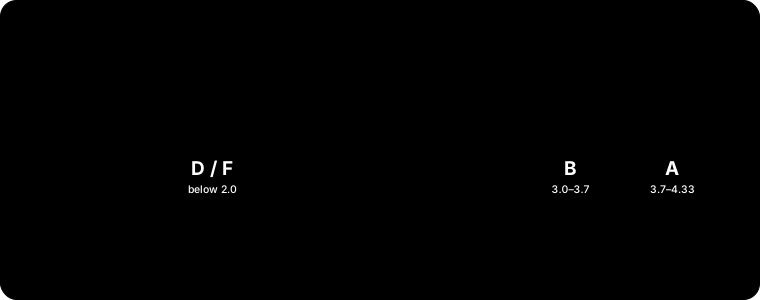
LSAC ignores the numeric or letter scale your school prints and re–maps every convertible grade onto one national scale. The most important quirk: an A+ is worth 4.33 grade points, so students whose registrars award A+ can post an LSAC GPA above a perfect 4.0. Intermediate marks such as AB and BC (used by some schools) get their own values too. The full conversion table, drawn from LSAC’s official Transcript Summarization guidelines, is below.

| Letter Grade | LSAC Grade Points |
|---|---|
| A+ | 4.33 |
| A | 4.00 |
| A– | 3.67 |
| AB | 3.50 |
| B+ | 3.33 |
| B | 3.00 |
| B– | 2.67 |
| BC | 2.50 |
| C+ | 2.33 |
| C | 2.00 |
| C– | 1.67 |
| CD | 1.50 |
| D+ | 1.33 |
| D | 1.00 |
| D– | 0.67 |
| DE | 0.50 |
| F / E | 0.00 |
How to Calculate Your LSAC GPA
The formula is the standard weighted average, applied after every grade is converted to LSAC grade points:
LSAC GPA = Σ(credit hours × grade points) ÷ Σ(credit hours)
Worked example. Suppose you took four courses: Biology (4 credits, A+ = 4.33), Calculus (3 credits, B = 3.00), History (3 credits, A– = 3.67), and Chemistry (4 credits, F = 0.00 — a failed course you later retook). Multiply credits by grade points to get quality points: Biology 4 × 4.33 = 17.32; Calculus 3 × 3.00 = 9.00; History 3 × 3.67 = 11.01; Chemistry 4 × 0.00 = 0.00. Sum the quality points: 17.32 + 9.00 + 11.01 + 0.00 = 37.33. Sum the credits: 4 + 3 + 3 + 4 = 14. Divide: 37.33 ÷ 14 = 2.67.
Notice that the failed Chemistry course contributed zero to the numerator but still added 4 credits to the denominator — dragging the GPA down even though your school may have forgiven it after the retake. That single detail is why the LSAC GPA so often surprises applicants.

How to Use the LSAC GPA Calculator
Work directly from your official transcripts, one line at a time, so nothing convertible is left out.

- Gather an official (or unofficial but complete) transcript from every U.S. or Canadian undergraduate institution you attended — including community college, dual-enrollment, summer, and study-abroad credits that appear on a domestic transcript.
- For each graded course, enter the credit hours and the letter grade. If your school uses percentages or a non-letter scale, map it to the closest LSAC letter first.
- Include every attempt of any repeated course — the original failing or low grade AND the retake. Do not delete the first attempt.
- Enter failed courses (F/E) as 0.00; they count in the denominator. Leave out Pass/Credit, Withdraw, and non-credit entries, which LSAC does not convert.
- Read your recalculated cumulative GPA on the 4.33 scale, and compare it to your degree GPA to see the CAS adjustment before you apply.
Why Your LSAC GPA Differs From Your School GPA
The CAS recalculation is deliberately stricter and more uniform than any single registrar, which is why the two numbers rarely match:
All undergraduate work counts. LSAC includes every convertible grade earned before your first bachelor’s degree was conferred, across all institutions. Courses taken after that degree date — including graduate and professional study — are excluded.
No grade replacement or forgiveness. If your school lets a retake erase a failing grade, LSAC does not: it counts both the original and the repeat. Academic-forgiveness and grade-replacement policies have zero effect on your LSAC GPA.
Failed courses always count. Any F or E on an official transcript converts to 0.00 and stays in the calculation, even if the credit never applied toward graduation.
The A+ bonus. Because LSAC values A+ at 4.33 while many schools cap it at 4.0, applicants at generous institutions can see their LSAC GPA rise above their degree GPA.
Pass/Fail is dropped. Passing grades from pass/fail systems are not converted, so a semester of P grades neither helps nor hurts.
Two practical consequences: LSAC needs at least 60 graded credits from U.S./Canadian schools to report a cumulative GPA, and there is no +/– rounding — a B– is exactly 2.67, never rounded to 3.0. Because CAS reports one national number, it is this figure — not your Dean’s List standing or Latin honors from your home campus — that law schools plug into their medians.
- Every U.S./Canadian undergraduate transcript is included
- Both attempts of every repeated course are entered
- All failed grades entered as 0.00, not omitted
- Pass/Credit and Withdraw grades left out (not converted)
- A+ grades entered at 4.33, not 4.0
- Only pre-degree coursework counted; graduate work excluded
Related GPA & Grade Calculators
Compare scales and plan your terms with our other tools: browse all GPA calculators, try the standard 4.0-scale VT GPA Calculator, or explore grade & curve calculators and the Grade Curve Calculator to see how a curved course grade feeds into your GPA. Pre-law students carrying AP score calculators credit can check our study guides for how those grades are (and are not) counted by CAS.
Frequently Asked Questions
Does LSAC really count failed and repeated courses?
Yes. This is the single biggest reason your LSAC GPA differs from your school GPA. If a grade and its credit hours appear on an official transcript, CAS includes them — both the original failing attempt and the retake. Institutional grade forgiveness or replacement policies do not carry over to LSAC.
What is a CAS GPA, and does this work for OLSAS too?
Your CAS GPA is the standardized GPA the Credential Assembly Service reports to law schools after re-computing every grade on LSAC’s 4.33 scale — exactly what this calculator produces. Other application services work the same way: OLSAS and similar centralized systems recalculate your grades on their own conversion table, so the method here mirrors an OLSAS GPA conversion even though the exact point values differ by service.
Why is my LSAC GPA higher than my college GPA?
Almost always the A+ conversion. LSAC assigns A+ a value of 4.33, so if your school awards A+ grades but caps them at 4.0, your CAS GPA can rise above your degree GPA — even above a 4.0.
What is the LSAC grade-point value for each letter?
A+ = 4.33, A = 4.00, A− = 3.67, B+ = 3.33, B = 3.00, B− = 2.67, C+ = 2.33, C = 2.00, C− = 1.67, D+ = 1.33, D = 1.00, D− = 0.67, and F/E = 0.00. Intermediate marks used by some schools also convert: AB = 3.50, BC = 2.50, CD = 1.50, DE = 0.50. There is no rounding of +/− grades.
Are Pass/Fail or Credit/No-Credit courses included?
No. Passing grades from pass/fail or credit systems cannot be converted to the 4.0 scale, so LSAC excludes them entirely. A failing grade in such a system may still be converted to 0.00 if it appears as a graded F on the transcript.
Does graduate coursework count toward my LSAC GPA?
No. LSAC only recalculates undergraduate work completed before your first bachelor’s degree was conferred. Any courses taken after that degree date, including graduate and professional study, are reported separately and excluded from the cumulative undergraduate GPA.
Do Dean's List or Latin honors affect my LSAC GPA?
No. Honors designations are recorded by your home institution and do not change the recalculated CAS number. Law schools use your standardized LSAC cumulative GPA for their admissions medians, so focus on that figure rather than campus honors.
How many credits do I need for LSAC to report a GPA?
You need at least 60 graded credit hours from U.S. or Canadian undergraduate institutions. Below that threshold, LSAC provides a qualitative designation instead of a numeric cumulative GPA.
Which schools' transcripts does LSAC include?
Every U.S. or Canadian undergraduate institution you attended before your first bachelor’s degree — community college, dual-enrollment high-school credit, transfer courses, and study-abroad grades that appear on a domestic transcript are all folded into one cumulative GPA.