AP Physics 1 Score Calculator: Raw Points to Your 1–5
Academic examsCalculate an AP Physics 1 weighted composite from MCQ and FRQ points.
Score thresholds
Editable estimated composite cutoffs. Official AP raw-score cutoffs are not published and can shift by exam year.
The AP Physics 1: Algebra-Based score calculator above turns your multiple-choice and free-response raw scores into a predicted 1–5 AP score. It reflects the redesigned exam (effective May 2025): 40 multiple-choice questions worth 50% and 4 free-response questions (40 points) worth 50%. Enter your points to see your estimated composite score and where it falls against this year's score cutoffs.
How the AP Physics 1 Score Calculator Works
The AP Physics 1: Algebra-Based score calculator mirrors the real exam's two-section design. You enter your raw score on Section I (up to 40 multiple-choice points) and your estimated points on Section II (up to 40 free-response points across 4 questions). The tool weights each half at 50%, sums them into a composite score out of 100, and maps that composite to a predicted 1–5 AP score using researched cutoffs.
Because the College Board never publishes the exact raw–to–scaled conversion for a given year, this AP Physics 1 score predictor is a model, not an official readout. Treat the 1–5 result as a well-calibrated estimate that tells you whether you are comfortably clear of a threshold or sitting right on a boundary where a few points matter.

Inputs: your multiple-choice raw score (0–40) and your free-response points (0–40). Outputs: a weighted composite score on a 0–100 scale and a predicted AP score of 1–5. Adjust either input to instantly see how many points separate you from the next grade band.
How the AP Physics 1 Exam Is Scored
AP Physics 1 was redesigned effective the May 2025 exam, and that redesigned format applies to the 2025 and 2026 exams. Per the official College Board exam page, the test runs about 3 hours and is split evenly between multiple choice and free response.
Section I has 40 single-select multiple-choice questions (four answer choices each, no multi-select) in 80 minutes, worth 50% of your score. Section II has 4 free-response questions in 100 minutes, also worth 50%, and totals 40 raw points. The four FRQ types are Mathematical Routines (10 pts), Translation Between Representations (12 pts), Experimental Design and Analysis (10 pts), and Qualitative/Quantitative Translation (8 pts). A calculator is now permitted on both sections.
| Section | Questions | Time | Weight | Raw points |
|---|---|---|---|---|
| I: Multiple Choice | 40 single-select | 80 min | 50% | 40 |
| II: Free Response | 4 questions | 100 min | 50% | 40 (10 + 12 + 10 + 8) |
| Total | 44 items | 180 min | 100% | 80 |
The Composite Score Formula, Shown Transparently
Since the two sections carry different raw totals (40 MCQ points versus 40 FRQ points) but equal weight, the calculator normalizes each to 50 and adds them. The transparent formula is:
Composite = (MCQ raw ÷ 40) × 50 + (FRQ raw ÷ 40) × 50
Worked example: Suppose you answer 28 of 40 multiple-choice questions correctly and earn 28 of 40 free-response points. Your MCQ contribution is (28÷40)×50 = 35.0, and your FRQ contribution is (28÷40)×50 = 35.0. The composite is 70.0 out of 100, which lands in the score 4 band (≥56). Raise your FRQ total to 36 of 40 and the composite climbs to 80.0 — into score 5 territory (≥74).
The College Board does not release the exact raw-score-to-1–5 conversion for any single year. The cutoffs here are researched approximations that shift slightly through annual equating. Use the predicted score as guidance, not a guarantee.
AP Physics 1 Score Cutoffs
The bands below show the approximate composite score cutoffs (out of 100) this calculator uses to convert your weighted total into a 1–5 AP score. A composite of 74 or higher predicts a 5, 56–73 predicts a 4, 42–55 predicts a 3, and 31–41 predicts a 2.
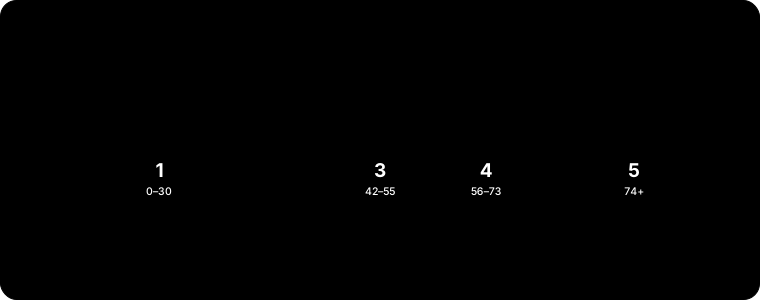
AP exams are equated so that a 4 means the same thing across years even when one form is harder. That means the real raw threshold for each score can drift by a few points from administration to administration. Aim to clear a cutoff with margin rather than landing exactly on it.
What Is a Good AP Physics 1 Score?
AP scores run 1–5. The College Board describes a 3 as “qualified,” a 4 as “well qualified,” and a 5 as “extremely well qualified.” A 3 or higher is commonly called passing, though “passing” is not an official term — the accurate framing is that a 3+ makes you eligible for college credit or placement at many institutions.
For a rigorous, math-heavy course like AP Physics 1, a 4 or 5 is a strong result that selective universities notice, while a 3 still earns credit at a large share of colleges. Always check the specific credit policy of the schools on your list — some engineering and physics programs require a 4 or 5 for placement out of an introductory sequence.

AP Physics 1 Score Distribution and Trends
The 2025 redesign produced the largest single-year jump in AP Physics 1 pass rates in the exam's history, and 2026 held those gains. According to the official College Board AP score distributions, roughly 184,000 students took the exam in 2026, with 68% scoring 3 or higher — a dramatic shift from the sub-50% pass rates common before the redesign. The chart shows the most recent 2026 distribution.

| Year | Mean (approx.) | % scoring 3+ |
|---|---|---|
| 2026 | ≈ 3.13 | 68% |
| 2025 | ≈ 3.12 | 67% |
What-If Mode: Points You Need to Reach Your Target Score
Working backward from a target composite is the fastest way to plan. The table below assumes you perform at a similar level on both sections; if one is your strength, you can trade points between them. These are approximate raw totals — plug your own split into the calculator to fine-tune.

| Goal score | Approx. MCQ (of 40) | Approx. FRQ (of 40) | Composite |
|---|---|---|---|
| 5 | 30 | 30 | ≈ 75 |
| 4 | 23 | 22 | ≈ 56 |
| 3 | 17 | 17 | ≈ 42 |
How to Get a 5 on AP Physics 1
A 5 rewards students who can move fluidly between words, equations, graphs, and experiments — exactly what the four FRQ types demand. For Mathematical Routines, show every step and carry units; for Translation Between Representations, practice converting a motion graph into an equation and back. On Experimental Design and Analysis, always identify variables, describe a procedure with a repeatable measurement, and justify how your data supports a claim. For Qualitative/Quantitative Translation, pair a plain-language physical explanation with the supporting math.
On multiple choice, pace yourself at roughly two minutes per question and use the on-screen calculator sparingly. The single biggest score driver is conceptual mastery of all eight units, including the newly added Fluids unit that many older prep books omit.
- Unit 1: Kinematics
- Unit 2: Force and Translational Dynamics
- Unit 3: Work, Energy, and Power
- Unit 4: Linear Momentum
- Unit 5: Torque and Rotational Dynamics
- Unit 6: Energy and Momentum of Rotating Systems
- Unit 7: Oscillations
- Unit 8: Fluids (new in the 2025 redesign)
How Accurate Is This AP Physics 1 Score Calculator?
This tool is a reliable directional estimate, not an official score. It uses the confirmed 50/50 section weighting and researched composite cutoffs, but the exact raw conversion changes each year through equating and is never publicly released by the College Board. When your predicted score sits right on a boundary, treat the outcome as “could go either way” and study to clear the next band with room to spare.
For details on how official scores are set and reported, see the College Board's About AP Scores resource. The most useful way to use this predictor is with real practice-exam raw scores, repeated over time to track improvement.
When Do AP Physics 1 Scores Come Out?
AP scores are released online in July of the same year you test, typically in a rolling window during the first half of the month. You access them through your College Board account with the same login used for registration. Until then, this AP Physics 1 score calculator is the best way to estimate where you likely landed based on how your practice exams and released free-response questions went.
Explore More AP Score Calculators
Taking more than one AP exam? Predict every score with our full set of AP score calculators. Popular science and history tools include the AP Chemistry Score Calculator, the AP Biology Score Calculator, and the APUSH Score Calculator. To plan your overall academics, try the GPA Calculator or the Grade Curve Calculator, and browse our study guides for subject-by-subject prep tips.
Physics and calculus usually travel together — estimate those scores with the AP Calc AB Score Calculator and the AP Calc BC Score Calculator.
Moving on to the calculus-based sequence? Try the AP Physics C Mechanics Score Calculator and the AP Physics C E&M Score Calculator.
Curious how AP Physics 1's curve compares with other subjects? See our AP score curves compared across every exam, the easiest and hardest AP exams ranked by real pass rates, and the full AP score distributions for every exam.
Frequently Asked Questions
Is the AP Physics 1 score calculator accurate?
It is an accurate directional estimate. It uses the confirmed 50/50 weighting between the 40-question multiple-choice section and the 40-point, 4-question free-response section, plus researched composite cutoffs. Because the College Board never publishes the exact raw-to-scaled conversion for a given year, treat borderline results as approximate.
How does the AP Physics 1 curve convert a raw score to a 1–5?
The AP Physics 1 curve isn’t published, so this calculator models it. It converts your multiple-choice and free-response raw scores into a weighted composite out of 100, giving each section 50%, then maps that composite to a 1–5: roughly 74+ earns a 5, 56–73 a 4, 42–55 a 3, and 31–41 a 2. Real cutoffs shift slightly each year through equating.
What is the format of the redesigned AP Physics 1 exam?
Effective the May 2025 exam, Section I has 40 single-select multiple-choice questions in 80 minutes (50%), and Section II has 4 free-response questions in 100 minutes (50%) worth 40 points total. The FRQ types are Mathematical Routines (10 pts), Translation Between Representations (12 pts), Experimental Design and Analysis (10 pts), and Qualitative/Quantitative Translation (8 pts). A calculator is allowed on both sections.
What score do I need to pass AP Physics 1?
A 3 or higher is considered qualified, which is the common meaning of "passing." In this calculator, a 3 corresponds to a composite of about 42 out of 100, roughly 17 of 40 multiple-choice points and 17 of 40 free-response points if you perform evenly across both sections.
What was the 2026 AP Physics 1 score distribution?
In 2026, about 19% earned a 5, 24% earned a 4, 25% earned a 3, 15% earned a 2, and 17% earned a 1, so roughly 68% scored 3 or higher across approximately 184,000 test-takers, per the College Board's official score distributions.
How many questions can I miss and still get a 5?
Roughly, scoring around 30 of 40 multiple-choice points and 30 of 40 free-response points yields a composite near 75, the estimated 5 threshold. You can miss more multiple-choice questions if you earn more free-response points, since the two sections are weighted equally.
Did AP Physics 1 get easier after the 2025 redesign?
The redesign trimmed the exam to 40 MCQs and 4 FRQs, added a Fluids unit, and allowed calculators throughout. Pass rates jumped to their highest level ever, with about 67% scoring 3+ in 2025 and 68% in 2026, though the underlying content remains rigorous.
When are AP Physics 1 scores released?
AP scores come out online in July of the testing year, usually in a rolling release during the first half of the month. You view them in your College Board account.
Does a 3 on AP Physics 1 earn college credit?
Often, yes. Many colleges grant credit or placement for a 3, but selective universities and engineering programs may require a 4 or 5. Always confirm each school's specific AP credit policy.