AP Computer Science Score Calculator: AP CSA Java Exam 1–5
Academic examsEstimate an AP Computer Science A composite from multiple-choice and free-response points.
Score thresholds
Editable estimated composite cutoffs. Official AP raw-score cutoffs are not published and can shift by exam year.
This AP Computer Science score calculator turns your raw multiple-choice and free-response totals into a weighted composite and a predicted AP CSA score of 1–5, using the current 42-question, 25-point exam structure from the official 2025-26 Course and Exam Description. Below the tool you will find the exact formula it runs, an honest account of why nobody's cutoffs are official, and what the strikingly bimodal 2025 score distribution means if you are sitting on the 3/4 line.
How the AP Computer Science A Score Calculator Works
Two different numbers get called "your AP score," and mixing them up is the most common reason students misjudge where they stand. Your raw score is what you actually earned: correct answers in Section I, rubric points in Section II. Your composite score is what College Board builds from those two raw totals after weighting each section onto a shared scale, and the composite is the only number that maps to a 1, 2, 3, 4 or 5. This AP Computer Science score calculator handles that conversion so you can go straight from a practice test to a realistic prediction.
AP Computer Science A weights Section I at 55% and Section II at 45%. The tool scales each raw total by its weight, adds them into a 100-point composite, and compares the result against the score bands. Change either input and the composite updates immediately, which is what makes it useful for planning rather than just grading — you can see exactly how many extra rubric points would push you across a boundary, and whether those points are cheaper to find in Section I or Section II.
One warning about other tools. The 2025-26 Course and Exam Description moved AP CSA from 40 multiple-choice questions to 42, from a 50/50 section split to 55/45, and from four 9-point free-response questions to a 25-point Section II. If you open an APCSA calculator that still asks for 40 multiple-choice answers and 36 free-response points, it is scoring the retired version of the course and its composite will be wrong for you. The donut below shows the weighting this tool actually applies.

| Question | Section | Max | Weight |
|---|---|---|---|
| Multiple Choice Correct | Multiple Choice | 42 | |
| Q1: Methods and Control Structures | Free Response | 7 | |
| Q2: Class Design | Free Response | 7 | |
| Q3: Data Analysis with ArrayList | Free Response | 5 | |
| Q4: 2D Array | Free Response | 6 |
Inputs: the number of multiple-choice questions you answered correctly (out of 42) and your free-response total (out of 25 — add up the four questions, which are worth 7 + 7 + 5 + 6). Outputs: a weighted composite out of 100, a predicted AP score from 1 to 5, and how far you sit from the next band. Editable: the cutoffs themselves, because College Board has never published them.
How the AP CSA Exam Is Scored
AP Computer Science A is a three-hour exam delivered fully digitally in Bluebook, College Board's testing application. Both sections are Java. Section I asks you to reason about code that already exists; Section II asks you to write code that does not exist yet. Course-level details are published on the official AP Computer Science A page at AP Central.
Section I is 42 multiple-choice questions in 90 minutes, worth 55% of your score, with four answer options (A–D) per question. In practice it mixes code tracing (what does this loop print?), code analysis (which implementation is equivalent?), and conceptual questions about inheritance, object references and data structures. Ninety minutes across 42 questions gives you a little over two minutes each — generous for a recall question, tight for a nested-loop trace you have to walk by hand.
Section II is four free-response questions in 90 minutes, worth 45%, and every one of them is Java code writing. This is where the current exam diverges most sharply from older prep material. The questions are no longer worth 9 points each. The 2025-26 CED (Exam Information, p. 145) lists Question 1 Methods and Control Structures at 7 points (Part A 4, Part B 3), Question 2 Class Design at 7 points, Question 3 Data Analysis with ArrayList at 5 points, and Question 4 2D Array at 6 points — 25 raw points in total, not 36.
The rubrics are criteria-first: readers look for specific things your code does correctly and award a point for each, rather than starting at full marks and subtracting. Penalty points exist, but they are capped at a maximum of 3 per question, and a penalty can only be deducted from a part that already earned credit. Two consequences matter under time pressure. First, a scattering of small slips cannot cascade into a zero on a question where your logic was sound. Second, there is no downside whatsoever to attempting a part you are unsure about, because a part that earns nothing cannot be pushed below nothing.
| Section | What it contains | Questions | Time | Weight |
|---|---|---|---|---|
| Section I: Multiple Choice | Code tracing, code analysis and concepts, four options (A–D) | 42 | 90 minutes | 55% |
| Section II: Free Response | Java code writing across four prompts worth 7, 7, 5 and 6 points | 4 | 90 minutes | 45% |
| Total | Fully digital, delivered in Bluebook | 46 | 3 hours | 100% |
| Question | Focus | Points | Share of Section II |
|---|---|---|---|
| Question 1 | Methods and Control Structures (Part A 4 points, Part B 3 points) | 7 | 28% |
| Question 2 | Class Design | 7 | 28% |
| Question 3 | Data Analysis with ArrayList | 5 | 20% |
| Question 4 | 2D Array | 6 | 24% |
| Total | Section II raw score | 25 | 100% |
The Composite Score Formula, With a Worked Example
The arithmetic is short enough to check by hand. Composite = (MC correct ÷ 42) × 55 + (FRQ points ÷ 25) × 45. Both terms land on the same 100-point scale, so they can simply be added.
Take a student who answers 30 of 42 multiple-choice questions correctly and earns 15 of 25 free-response points. Multiple choice: 30 ÷ 42 = 0.7143, and 0.7143 × 55 = 39.29 composite points. Free response: 15 ÷ 25 = 0.60, and 0.60 × 45 = 27.00 composite points. Composite = 39.29 + 27.00 = 66.29, which falls in the 59–77 band and predicts a 4. Notice what that student did not need: they missed 12 multiple-choice questions and gave up 10 rubric points and still cleared a 4 with room to spare.
Now a weaker paper. A student answers 24 of 42 multiple choice and earns 11 of 25 free-response points. Multiple choice: 24 ÷ 42 = 0.5714, × 55 = 31.43. Free response: 11 ÷ 25 = 0.44, × 45 = 19.80. Composite = 31.43 + 19.80 = 51.23 — a 3, sitting roughly five composite points above the estimated boundary at 46. That is a real 3, but not a safe one.
The formula also tells you where revision time pays best. One multiple-choice question is worth 55 ÷ 42 = 1.31 composite points. One free-response rubric point is worth 45 ÷ 25 = 1.80 composite points. A single rubric point is therefore worth about 1.4 multiple-choice questions. With only 25 rubric points on the entire exam, each one carries unusual weight — which is exactly why writing partial, plausible, compiling-looking code for a question you cannot fully solve beats leaving it blank every single time.
AP CSA Score Cutoffs: Where a 3, 4 and 5 Begin
College Board has never published the raw-score-to-AP-score conversion for AP Computer Science A, and there is no sign that it intends to. Cutoffs are set after each administration through a standard-setting process that compares that year's cohort against the course's performance standards, which means the boundaries shift slightly from year to year with question difficulty. Anyone who tells you a 5 starts at exactly some number of questions is estimating — including us. The difference is that we say so.
There is a second reason to distrust any cutoff you find quoted as fact right now. Because the exam itself changed shape in 2025-26 — different question count, different section weights, a 25-point Section II instead of a 36-point one — historical curve estimates built on the old course do not transfer. A raw total that was borderline under the retired structure maps to a different composite under this one, so old rules of thumb like "you need about two-thirds of the points" are worth less than they look.
The bands this AP Computer Science score calculator uses by default are shown below on the 100-point composite scale: 5 = 78+, 4 = 59–77, 3 = 46–58, 2 = 35–45, 1 = 0–34. They are calibrated so that the resulting spread roughly reproduces the published 2025 outcome distribution. Every boundary is editable, so if your teacher uses a stricter curve or you want to stress-test a pessimistic scenario, type in your own numbers and the prediction re-runs instantly.
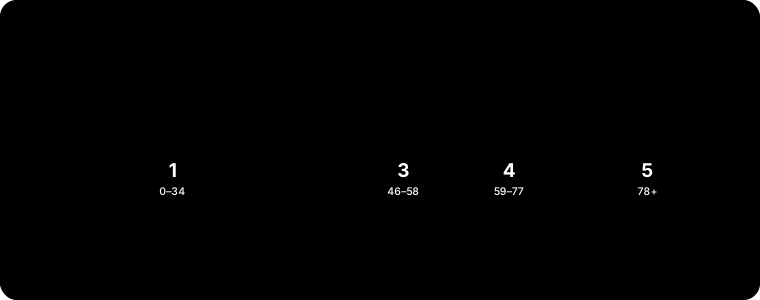
College Board does not release official raw-score cutoffs for AP CSA. There is also a live sourcing caveat worth stating plainly: AP Central has published the 2026 free-response questions, but not a 2026 scoring guidelines PDF — the most recent published guidelines are from 2025, the final year of the old course. The 2025-26 Course and Exam Description is therefore currently the authoritative source for the 25-point free-response total. Treat any predicted score within about three composite points of a boundary as a coin flip rather than a result.
What Is a Good AP Computer Science A Score?
The formal answer is that 3 is the score College Board describes as qualified, and 67.2% of the 93,217 students who sat AP CSA in 2025 reached it. The mean score that year was 3.18. So a 3 puts you on the right side of the line, and anything at or above a 4 puts you comfortably above the cohort average.
The practical answer depends on what you want the score to do. If you want credit or placement, that is a per-institution question and policies genuinely vary — some departments grant credit at a 3, many competitive computer science programs want a 4 or a 5, and some grant placement without credit. Look up the specific institution's AP credit policy rather than trusting a general rule, because CS departments are among the more selective about which AP scores they honour.
There is also a context-specific wrinkle in AP CSA. A quarter of test-takers earn a 5, which is a higher share than in many AP subjects, so a 5 here differentiates you slightly less than the same score would in a subject where fives are scarce. The flip side is that a 1 is unusually common too. The reason for both is visible in the distribution, and it is the single most useful thing to understand about this exam.

The AP CSA Score Distribution Is Bimodal — And That Changes Your Strategy
Here is the 2025 breakdown from the AP Students score distributions page, the latest complete official year: 25.6% earned a 5, 21.8% earned a 4, 19.8% earned a 3, 10.9% earned a 2, and 22.0% earned a 1. (A full 2026 breakdown with a published mean and cohort size was not yet available when this page was updated, so 2025 remains the most reliable picture.) Read those numbers as a shape rather than a list and something jumps out. The two tallest bars are at the extremes. The smallest bar is at 2.
Most AP exams produce a hump in the middle — lots of 3s, fewer results at either end. AP CSA produces two peaks with a thin waist between them. That pattern is characteristic of a skills-based programming exam rather than a knowledge-based one. There is essentially one underlying competency being tested: can you write and reason about working Java? Students who can do that tend to do it across all four free-response questions and most of the multiple choice, so they score very high. Students who cannot tend to struggle uniformly, so they score very low. There is not much territory in between for a student who half-knows the material, because half-knowing how to write a loop does not produce half-working code.
For a borderline student the practical implication is unusually encouraging. Improvement on AP CSA is not a slow accumulation across a wide syllabus — it is a threshold you cross. Once you can reliably write a method that loops over a structure, tests a condition and returns the right type, a large fraction of the paper opens up at once, in both sections. The students stuck in the 1–2 range are usually missing that one composite skill, not thirty separate facts.
It also means Section II is where the leverage is, because those four question types are stable year over year. The table below shows the trade-off concretely: for a given multiple-choice total, how many free-response points you need for each band.

| Multiple choice correct (of 42) | FRQ points for a 3 | FRQ points for a 4 | FRQ points for a 5 |
|---|---|---|---|
| 20 | 12 of 25 | 19 of 25 | Not reachable (max composite 71.2) |
| 25 | 8 of 25 | 15 of 25 | Not reachable (max composite 77.7) |
| 30 | 4 of 25 | 11 of 25 | 22 of 25 |
| 35 | 1 of 25 | 8 of 25 | 18 of 25 |
| 38 | 0 — already a 3 | 6 of 25 | 16 of 25 |
Study Strategy: How to Move Up One Score Band
Start by finding out where you actually are, not where you feel you are. Sit a full 42-question multiple-choice section under a 90-minute timer, score it honestly, then run the number through the calculator. The composite tells you how many points you need, and the what-if table tells you the cheapest place to find them. A student on 51 needs about eight composite points for a 4; at 1.80 composite points per rubric point, that is roughly four or five extra free-response marks, which is one question's worth.
For Section I, the highest-yield habit is hand-tracing. Most multiple-choice errors on AP CSA are bookkeeping failures rather than concept gaps — an off-by-one in a loop bound, a variable that was reassigned two lines earlier, an object reference you assumed was a copy. Writing a small trace table with a column per variable converts those from guesses into arithmetic.
For Section II, practise the way the exam works: write code by hand or in a plain editor with autocomplete switched off, finish the whole question, and only then compile it to find out what you actually got wrong. Autocomplete quietly does the part of the job the rubric is testing. And because the four question archetypes barely move year to year, drilling them specifically — methods and control structures, class design, ArrayList data analysis, 2D arrays — is far more efficient than working through problems at random.

- Sit a full 42-question multiple-choice section under a real 90-minute timer before anything else — you need a baseline, not an estimate.
- Hand-trace loops, recursion and object references with a written trace table; most Section I losses are bookkeeping, not concepts.
- Write free-response answers in a plain editor with autocomplete off, then compile afterwards to see what you genuinely got wrong.
- Drill the four recurring FRQ archetypes: methods and control structures, class design, ArrayList data analysis, and 2D arrays.
- Never leave an FRQ part blank — penalties are capped at 3 per question and can only be taken from parts that already earned credit, so an attempt carries no downside.
- Re-read your method signature against the prompt before moving on; wrong return types and ignored parameters cost criteria points that were free.
- Know the standard String, ArrayList and array methods well enough to write them without pausing, so Section II time goes to logic instead of recall.
- Recompute your composite after every practice test and log it — watching one number move is a better progress signal than a pile of percentages.
When Do AP Computer Science A Scores Come Out?
AP scores are released in early July. For the 2026 administration, scores were released on Monday, July 6, 2026, viewable at scores.collegeboard.org by signing in with the same College Board account you used to register. Release is staggered in practice, so if a friend in another state sees theirs first, that is normal and says nothing about your result.
Between test day and release there is nothing you can do to change the outcome, but you can bracket it. Reconstruct your multiple-choice performance as honestly as you can, estimate your rubric points question by question against the four point values (7, 7, 5 and 6), and run both a pessimistic and an optimistic version through the calculator. If both land in the same band, you can stop worrying. If they straddle a boundary, you now know precisely which decision — a college's credit policy, a placement test, a course registration — actually depends on the result.
Explore More AP Score Calculators
This AP Computer Science score calculator is one of a set that all work the same way — weight each section, add them onto a 100-point composite, compare against editable bands. Only the weights and raw totals change from subject to subject. Browse them all under AP exam score calculators.
The closest relative is AP Computer Science Principles, and the difference is worth spelling out because students search for the two interchangeably. AP CSA is Java programming: you trace code in Section I and you write code in Section II. AP CSP is broad conceptual computing — algorithms, data, the internet, the impacts of computing — and it includes a Create performance task that you build and submit before exam day rather than a code-writing section you complete under the timer. Searching for an AP Comp Sci A score calculator or an AP CSA score calculator brings you here; if your course involved a Create task, you want the CSP tool instead.
Other quantitative subjects using the same method: AP Calculus AB, AP Statistics, AP Physics 1 and AP Chemistry. For classroom marks rather than AP exams, the grade curve calculator applies the same logic to a course curve, and the blog tracks scoring changes as College Board announces them.
Curious how AP Computer Science A's curve compares with other subjects? See our AP score curves compared across every exam, the easiest and hardest AP exams ranked by real pass rates, and the full AP score distributions for every exam.
Frequently Asked Questions
How accurate is this calculator's predicted AP score?
It is precise about the mechanics and honest about the uncertainty. The section weights (55% multiple choice, 45% free response) and the raw totals (42 questions and 25 rubric points) come directly from the official 2025-26 Course and Exam Description, so the composite it produces is exactly right. The 1–5 boundaries are the estimated part: College Board has never published raw-score cutoffs for AP CSA, so ours are calibrated against the published 2025 distribution and are fully editable. If your composite sits within about three points of a boundary, read the output as a range rather than a verdict.
Is this AP CSA score calculator updated for the new 42-question, 25-point exam?
Yes. The pre-2026 course had 40 multiple-choice questions at 50% and four 9-point free-response questions for a 36-point Section II. The 2025-26 CED replaces that with 42 multiple-choice questions at 55% and free-response questions worth 7, 7, 5 and 6 points for 25 total at 45%. A great many calculators online still run the old 40/36 model, which shifts every composite it produces. This one uses the current figures.
How many questions do I need right to get a 5 on AP CSA?
There is no single answer, because the two sections trade off against each other. Using our default cutoff of 78, a student with 30 of 42 multiple choice needs about 22 of 25 free-response points; at 35 multiple choice that falls to about 18; at 38 it falls to about 16. Below 26 correct multiple-choice answers, a 5 becomes arithmetically unreachable even with a flawless Section II. Enter your own numbers above to see your exact target.
Is the AP CSA free-response section really only 25 points now instead of 36?
That is what the official 2025-26 Course and Exam Description states in its Exam Information section (p. 145): 7 + 7 + 5 + 6 = 25. One caveat we will state plainly — AP Central has posted the 2026 free-response questions but has not yet posted 2026 scoring guidelines, so the CED is currently the authoritative source rather than a released rubric. For contrast, the 2025 scoring guidelines, from the final year of the old course, show 9 points per question for 36 total at a 50/50 section split.
Why is the AP Computer Science A score distribution shaped so oddly?
Because it is bimodal. In 2025, 25.6% earned a 5 and 22.0% earned a 1, with only 10.9% at a 2 — two peaks at the extremes and a thin middle. That is the signature of a skills-based programming exam: there is essentially one underlying competency being assessed, so students who can write working Java score well across the whole paper, and students who cannot struggle across the whole paper. Half-knowing how to write a loop does not produce half-working code.
Do penalty points wipe out my free-response score?
No. Penalties on AP CSA free-response questions are capped at a maximum of 3 penalty points per question, and a penalty can only be deducted from a part that already earned credit. A part that scored zero cannot be pushed any lower. Combined with criteria-first rubrics — readers award points for what your code does right rather than subtracting from a perfect start — that is the strongest possible argument for attempting every part of every question.
What percentage of students get a 5 on AP Computer Science A?
In 2025, the latest complete official year, 25.6% of the 93,217 test-takers earned a 5. Adding the 21.8% who earned a 4 and the 19.8% who earned a 3 gives 67.2% scoring 3 or higher, and the mean score was 3.18. The remaining 10.9% earned a 2 and 22.0% earned a 1.
What is the difference between AP CSA and AP CSP?
AP Computer Science A is Java programming — Section I asks you to trace and analyse existing code, Section II asks you to write four Java solutions under time. AP Computer Science Principles is a broad conceptual computing course covering algorithms, data, the internet and computing's impacts, and it includes a Create performance task that you build and submit before exam day. If your course was mostly writing Java, you want this page; if it included a Create task, use the AP CSP score calculator instead.
When will I get my 2026 AP CSA scores?
AP scores are released in early July. The 2026 scores were released on Monday, July 6, 2026, at scores.collegeboard.org, accessed with the College Board account you used to register for the exam. Release rolls out in waves, so seeing a classmate's score before yours means nothing about your own result.