ASU Grade Calculator: Arizona State University Grading Scale
GradesCalculate current grade from weighted coursework categories.
| Category | Score | Max | Weight % | Remove |
|---|---|---|---|---|
The ASU Grade Calculator turns your weighted assignment scores into a single Arizona State University course grade — and shows the matching letter grade, grade points, and GPA impact using ASU's official plus/minus scale, where a failing grade is an E (0.00), an A+ is worth 4.33 (GPA capped at 4.00), and there is no C−.
How the ASU Grade Calculator Works
The ASU Grade Calculator takes each graded component of your course — exams, quizzes, homework, projects, participation, and the final — along with the weight your syllabus assigns to each one, and combines them into a single weighted course grade. Instead of averaging your scores as if they all counted equally, it multiplies each category score by its weight so a 40% final exam moves your grade far more than a 5% quiz. Once it produces a course percentage, you can map that number to an ASU letter grade and its grade points to understand how the class will affect your Arizona State University GPA.

Inputs: the name, earned score (points or percentage), and weight of each graded category from your Arizona State University (ASU) syllabus — for example Homework 15%, Quizzes 15%, Midterm 30%, Final 40%. Outputs: your current weighted grade as a percentage, the equivalent ASU letter grade and grade-point value, and (optionally) the score you still need on remaining work to reach a target grade. Weights should sum to 100% for a full-course estimate, but the tool can also show your standing on graded work so far.
The Official ASU Grading Scale
Arizona State University uses a plus/minus grading system, but with two features that surprise students coming from high school. First, ASU does not use the letter F — a failing grade is recorded as E and is worth 0.00 grade points. Second, ASU's scale has no C− and no D+ or D−: it drops from C (2.00) straight to D (1.00). An A+ carries an internal value of 4.33, but your cumulative GPA is capped at 4.00, so a string of A+ grades cannot lift you above a perfect 4.0. ASU does not publish a single university-wide percentage-to-letter cutoff — each instructor sets the thresholds on the syllabus — so the percentage column below reflects the typical ranges most ASU courses use, not a fixed official rule. You can confirm the current grade-point values on ASU's University Registrar grades page.
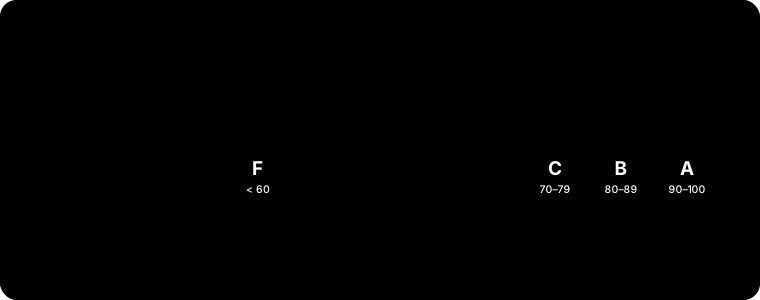
| Letter Grade | Grade Points | Typical Percentage | Meaning |
|---|---|---|---|
| A+ | 4.33 (capped at 4.00) | 97–100% | Highest distinction |
| A | 4.00 | 93–96% | Excellent |
| A− | 3.67 | 90–92% | Excellent |
| B+ | 3.33 | 87–89% | Good |
| B | 3.00 | 83–86% | Good |
| B− | 2.67 | 80–82% | Good |
| C+ | 2.33 | 77–79% | Above average |
| C | 2.00 | 70–76% | Average (undergrad); passing (grad) |
| D | 1.00 | 60–69% | Passing; no graduate credit |
| E | 0.00 | Below 60% | Failure (ASU's F) |
How Weighted Grades Work (With a Worked Example)
A weighted grade reflects how much each category contributes to the final course total. The formula is simple: multiply each category's percentage score by its weight (as a decimal), add those products together, and divide by the total weight. When weights sum to 100%, the divisor is 1, so the weighted grade is just the sum of the weighted pieces.
Imagine an ASU course with this syllabus: Homework 15%, Quizzes 15%, Midterm 30%, Final 40%. Suppose you earned Homework 92%, Quizzes 85%, Midterm 78%, and Final 88%. The math looks like this:
• Homework: 92 × 0.15 = 13.80
• Quizzes: 85 × 0.15 = 12.75
• Midterm: 78 × 0.30 = 23.40
• Final: 88 × 0.40 = 35.20
Add them: 13.80 + 12.75 + 23.40 + 35.20 = 85.15%. On the typical ASU scale that is a B, worth 3.00 grade points. Notice that the strong 92% homework barely nudged the total because it carried only 15% weight, while the 40% final did most of the heavy lifting — the essence of why an ASU grade calculator beats a plain average.

How to Use the ASU Grade Calculator
Follow these steps to turn your syllabus into an accurate grade estimate.

- Open your ASU course syllabus and list every graded category with its weight (Homework, Quizzes, Exams, Project, Final, Participation, etc.).
- Enter each category into the calculator with the weight shown on the syllabus. Confirm the weights add up to 100% for a full-course projection.
- Type in your earned score for each category as a percentage (or as points earned out of points possible).
- Read your weighted course percentage, then match it to the ASU letter grade and grade-point value in the table above.
- Leave a category blank or use the "what-if" field to test the score you need on a remaining exam to hit a target letter grade.
- Multiply the resulting grade points by the course's credit hours to see how this class will move your ASU GPA.
ASU-Specific GPA Policies Worth Knowing
A few Arizona State University rules directly affect how your calculated grade becomes your GPA. ASU computes GPA as Honor Points ÷ Net Hours: multiply each course's grade points by its credit hours, sum those honor points across all courses, and divide by total graded hours, rounding to the nearest hundredth. Marks of I (Incomplete), W (Withdrawal), X (Audit), Y (Satisfactory), and Z (Course in Progress) earn no grade points and are excluded from the GPA calculation, while EN, EU, and XE (academic dishonesty) all count as an E (0.00). Under ASU's Grade Replacement Opportunity, undergraduates who repeat certain courses can have the original grade removed from the GPA — useful to remember when you model a comeback semester. Because the A+ bonus is capped, aim your calculator targets at the A (93%+) threshold rather than chasing the 97% A+ line for GPA purposes. For the official GPA formula and step-by-step figures, see ASU's GPA calculation guide.

- Confirm every category weight comes from the current syllabus, not a guess.
- Check that weights total 100% for a full-course grade.
- Use your instructor's percentage cutoffs if the syllabus lists them, since ASU has no universal scale.
- Remember E, not F, is the failing grade — and it is worth 0.00.
- Multiply by credit hours before comparing the course to your overall ASU GPA.
Related Grade & GPA Calculators
Fine-tune every part of your academic picture with these tools. Use our VT GPA Calculator — a standard 4.0-scale tool — to combine several courses into a term or cumulative GPA, or browse all GPA calculators for more school-specific versions. If an instructor curves an exam, the Grade Curve Calculator and the Grading Bell Curve Calculator show how your raw score shifts, and the full set of grade & curve calculators covers every method. Planning ahead for credit? Compare outcomes with our AP score calculators, and visit the study guides for exam-prep strategy.
Frequently Asked Questions
Does ASU use an F grade?
No. Arizona State University records a failing grade as E, not F, and it is worth 0.00 grade points. Related failing marks — EN (never participated), EU (did not complete), and XE (academic dishonesty) — are all treated as an E when your GPA is calculated.
What is the Arizona State University grading scale?
Arizona State University uses a plus/minus letter scale where A+ and A are both worth 4.00 grade points, down to E (ASU's failing mark) at 0.00. This ASU grade calculator converts your weighted course percentage into a letter using the official Arizona State University grading scale shown in the table above, and those same grade points are what your ASU GPA is built from.
Is there a C− grade at ASU?
No. ASU's plus/minus scale has no C− (and no D+ or D−). The scale moves directly from C at 2.00 grade points to D at 1.00. This is a common surprise, so double-check your instructor's cutoffs when a borderline C is on the line.
How much is an A+ worth at ASU?
An A+ has an internal grade-point value of 4.33, but ASU caps the cumulative GPA at 4.00. That means A+ grades cannot raise your GPA above a perfect 4.0, so for GPA planning the practical target is the A threshold (typically 93%+).
How does ASU calculate GPA?
ASU uses Honor Points ÷ Net Hours = GPA. Multiply each course's grade-point value by its credit hours to get honor points, add the honor points from every graded course, then divide by your total graded (net) hours. The result is rounded to the nearest hundredth.
What percentage do I need for an A at ASU?
ASU does not publish a single university-wide percentage cutoff — each instructor sets the thresholds on the course syllabus. Most ASU courses use a typical scale where roughly 93–96% is an A and 90–92% is an A−, but always follow the exact percentages listed in your syllabus.
Why is my weighted grade different from a simple average?
A simple average treats every assignment equally, while a weighted grade multiplies each category by its syllabus weight. A high homework score with 10% weight barely moves your grade, while a final worth 40% can swing it several letter grades. The ASU grade calculator reflects that real impact.
Do incomplete or withdrawal grades affect my ASU GPA?
No. Marks of I (Incomplete), W (Withdrawal), X (Audit), Y (Satisfactory), and Z (Course in Progress) earn no grade points and are excluded from the GPA calculation. An unresolved Incomplete, however, may convert to an E after ASU's time limit, which would then count as 0.00.
Can I raise my GPA by retaking a course at ASU?
Possibly. Under ASU's Grade Replacement Opportunity, eligible undergraduates who repeat a qualifying course can have the original grade excluded from the GPA, keeping only the repeat. Rules and limits apply, so confirm eligibility with the University Registrar or your advisor before relying on it.