AP World Calculator: Your AP World History Score, Estimated
Academic examsCombine MCQ, SAQ, DBQ, and LEQ scores into one AP World composite.
Score thresholds
Editable estimated composite cutoffs. Official AP raw-score cutoffs are not published and can shift by exam year.
The AP World History: Modern score calculator above turns your multiple-choice, SAQ, DBQ, and LEQ points into a predicted 1–5 score in seconds. Enter your results from a practice test or estimate your exam performance, and the tool computes a weighted composite score and maps it to your likely AP grade using data-driven cutoffs — no sign-up required.
How the APWH Calculator Works
The AP World History: Modern score calculator above works by taking the points you expect to earn on each part of the exam — the 55 multiple-choice questions, the 3 short-answer questions (SAQ), the document-based question (DBQ), and the long essay question (LEQ) — and converting them into a single weighted composite score out of 100. That composite is then mapped to a predicted 1–5 AP score using estimated cutoffs, so you can see roughly where your current performance lands before test day.
Because it is fully transparent, this AP World score predictor is ideal for practice tests: enter your raw score from a released or mock exam, and instantly find out whether you are tracking toward a 3, a 4, or a 5. It also drives a what-if mode so you can experiment with how many more MCQ or free-response points you need to reach your target.

Inputs: MCQ correct (out of 55), SAQ points (out of 9 total, 3 each), DBQ points (out of 7), and LEQ points (out of 6). Outputs: a weighted composite out of 100, your section-by-section contribution, and a predicted 1–5 score based on estimated cutoffs. No login, no personal data — just move the sliders and read your result.
How the AP World History: Modern Exam Is Scored
AP World History: Modern is a fully digital exam delivered in the Bluebook app, lasting about 3 hours 15 minutes. It is split into two sections. Section I pairs 55 multiple-choice questions (in stimulus-based sets of 3–4) worth 40% of your score with 3 short-answer questions worth roughly 20%. Section II is the two-essay free-response section: a document-based question worth 25% and a long essay worth 15%. Full details are on the College Board AP World History: Modern exam page.
Each MCQ is worth one raw point with no penalty for guessing. Each SAQ is graded out of 3 points, the DBQ out of 7 points, and the LEQ out of 6 points. College Board then weights these parts and converts the total to the 1–5 scale. The table below shows the official structure the calculator mirrors.
| Section | Questions | Time | Weight | Raw points |
|---|---|---|---|---|
| I, Part A — Multiple Choice | 55 MCQ | 55 min | 40% | 55 |
| I, Part B — Short Answer | 3 SAQ | 40 min | ~20% | 9 (3 each) |
| II — Document-Based Question | 1 DBQ | ~60 min | 25% | 7 |
| II — Long Essay Question | 1 LEQ | 40 min | 15% | 6 |
| Total | — | ~3h 15m | 100% | — |
The Composite Score Formula, Shown Transparently
To build the composite score, each part is scaled to its weight on a 100-point scale. Multiple choice is worth 40 points, so each correct answer adds 40 ÷ 55 ≈ 0.727 points. The three SAQs share 20 points, so each SAQ point is worth 20 ÷ 9 ≈ 2.22. The DBQ's 7 points map to 25 composite points (≈ 3.57 each), and the LEQ's 6 points map to 15 composite points (2.5 each).
Worked example: suppose you get 40 of 55 MCQs, 6 of 9 SAQ points, 5 of 7 on the DBQ, and 4 of 6 on the LEQ. That is (40÷55×40) + (6÷9×20) + (5÷7×25) + (4÷6×15) = 29.1 + 13.3 + 17.9 + 10.0 = ≈70 composite points. Against the estimated cutoffs, a 70 comfortably clears the 58-point line for a 4 and puts a 5 within reach.
College Board does not publish the exact raw-to-1–5 conversion or the precise weighting used each year, and the cutoffs are re-set annually through a process called equating. The composite formula and thresholds here are careful estimates based on historical data — treat every prediction as a guide, not a guarantee.
AP World History Score Cutoffs
On the calculator's estimated 100-point composite scale, the score cutoffs below separate each AP grade. These bands are approximate: the real curve shifts slightly every year, but they closely track recent administrations and are useful for gauging where you stand.
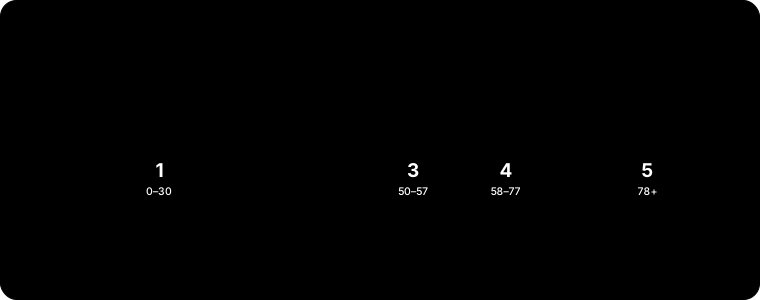
College Board uses equating so that a 5 means the same thing regardless of how hard a particular year's questions were. If a form is tougher, the raw composite needed for each score can drop a little. That is why a 70/100 might be a solid 4 one year and a borderline 4 another — always leave yourself a cushion above the cutoff.
What Is a Good AP World History Score?
AP scores run from 1 to 5. College Board describes a 5 as "extremely well qualified," a 4 as "well qualified," and a 3 as "qualified." A score of 3 or higher is commonly called "passing," though "passing" is not an official College Board term — it is more accurate to say 3+ is qualified for potential college credit.
What counts as "good" ultimately depends on your target colleges. Many schools grant credit or placement for a 4 or 5, while some accept a 3; selective universities may require a 5. Always check each school's specific AP credit policy. For most students, a 4 or 5 is the goal, and even a 3 demonstrates college-level mastery of world history.

AP World History Score Distribution and Trends
In 2025, more than 412,000 students took AP World History: Modern. The mean score was 3.16, and 64.3% scored a 3 or higher. The chart below shows the official 2025 breakdown from the College Board score distributions page.
Results have been remarkably stable year over year. In 2024, the mean was 3.11 with 63.7% scoring 3+, so 2025 ticked up slightly on both measures. Notably, the share of 5s rose from 11.9% to 13.9%, and the share of 4s climbed just above one-third of all test-takers.

| Year | Mean score | % scoring 3+ | % earning a 5 |
|---|---|---|---|
| 2025 | 3.16 | 64.3% | 13.9% |
| 2024 | 3.11 | 63.7% | 11.9% |
What-If Mode: Points You Need to Reach Your Target Score
One of the most useful features of this AP World score calculator is what-if planning. Because no single combination is required, the table below shows one balanced path to each target — you can trade MCQ points for stronger essays or vice versa. Figures are approximate and assume typical performance across the DBQ, LEQ, and SAQs.

| Goal score | Approx. MCQ (of 55) | Approx. FRQ points (SAQ+DBQ+LEQ) | Composite (of 100) |
|---|---|---|---|
| 5 | ~45 | ~7/9 + 6/7 + 5/6 | ~80 |
| 4 | ~35 | ~5/9 + 4/7 + 3/6 | ~58 |
| 3 | ~32 | ~4/9 + 3/7 + 3/6 | ~50 |
How to Get a 5 on AP World History
A 5 rewards mastery of both content and the exam's writing skills. On multiple choice, practice reading stimulus sources quickly and eliminating anachronistic answers — the sets reward contextualization, not memorized trivia. On the SAQs, answer every part directly with a specific example; there is no thesis, so speed and precision win points. The DBQ is the highest-value single task: earn the thesis and contextualization points, use at least four documents to support your argument, source at least two documents (historical situation, intended audience, purpose, or point of view), and bring in outside evidence. The LEQ is scored on a clear thesis, contextualization, specific evidence, and sophisticated reasoning — comparison, causation, or continuity and change.
Master these nine units and the reasoning skills below, take timed practice exams, and use the calculator to confirm you are consistently clearing the 5 cutoff before test day.
- Unit 1 — The Global Tapestry (c. 1200–1450)
- Unit 2 — Networks of Exchange (c. 1200–1450)
- Unit 3 — Land-Based Empires (c. 1450–1750)
- Unit 4 — Transoceanic Interconnections (c. 1450–1750)
- Unit 5 — Revolutions (c. 1750–1900)
- Unit 6 — Consequences of Industrialization (c. 1750–1900)
- Unit 7 — Global Conflict (c. 1900–present)
- Unit 8 — Cold War and Decolonization (c. 1900–present)
- Unit 9 — Globalization (c. 1900–present)
- Skills: contextualization, sourcing, claims & evidence, argumentation, and the reasoning processes of comparison, causation, and continuity & change
How Accurate Is This AP World History Score Calculator?
This tool is an estimate, and it is accurate to the degree that the current year's curve matches historical patterns. Because College Board does not release the exact raw-to-1–5 conversion and re-equates the exam annually, your real result may land a point above or below the prediction near a boundary. The essay rubrics also involve human scoring, so your self-estimated DBQ or LEQ points carry some uncertainty. Use the calculator for direction — to know whether you are near a 3, 4, or 5 — rather than as an exact forecast. You can read more about how scores are set and reported on the College Board AP scores page.
When Do AP World History Scores Come Out?
AP scores are released in July each year. Students access their scores online through their College Board account. Exact release dates vary slightly by year and are staggered by region, but early-to-mid July is the norm. Until then, this AP World History: Modern score calculator 2026 is the best way to estimate where you likely landed after taking the exam in May.
Explore More AP Score Calculators
Taking more than one AP exam? Browse our full library of AP score calculators to plan every subject. Popular tools include the APUSH Score Calculator, the AP Chem Score Calculator, the AP Bio Score Calculator, and the AP Physics 1 Score Calculator. For classroom grades, try the Grade Curve Calculator or read study guides on our blog.
Social studies students often pair this exam with human geography — the AP Human Geography Score Calculator predicts that 1–5 too.
European history follows an identical rubric structure — predict that result with the AP Euro Score Calculator.
Curious how AP World History's curve compares with other subjects? See our AP score curves compared across every exam, the easiest and hardest AP exams ranked by real pass rates, and the full AP score distributions for every exam.
Frequently Asked Questions
How is the AP World History: Modern exam scored?
Section I is 55 multiple-choice questions (40%) plus 3 short-answer questions (~20%). Section II is the document-based question (25%) and the long essay question (15%). College Board weights these parts, sums them into a composite, and converts it to a 1–5 score.
Is this an APWH calculator or a WHAP exam calculator?
Both — APWH and WHAP are student shorthand for AP World History. This APWH calculator doubles as a WHAP exam calculator, an AP World score calculator, and an AP World History grade calculator. Whichever name you use, it is one tool: enter your multiple-choice, SAQ, DBQ and LEQ points and it returns a weighted composite and a predicted 1–5.
Is this an AP World calculator or an AP World History calculator?
Both — an AP World calculator, an AP World score calculator, and an AP World History (APWH) calculator all mean this same tool for AP World History: Modern. Whether you searched “ap world calculator,” “score calculator ap world,” or “ap world exam score calculator,” it converts your section points into a predicted 1–5 score.
What composite score do I need for a 5 on AP World History?
On this calculator's estimated 100-point scale, a 5 starts around 78, a 4 around 58, a 3 around 50, and a 2 around 31. These cutoffs are estimates — the real curve is re-equated each year and never officially published.
Is a 3 on AP World History a passing score?
A 3 is officially described as "qualified," and many people call 3+ "passing," though that is not an official College Board term. Many colleges grant credit or placement for a 3, 4, or 5, but policies vary — check each school.
What was the AP World History score distribution in 2025?
In 2025, 13.9% scored a 5, 33.4% a 4, 17.0% a 3, 26.5% a 2, and 9.2% a 1. The mean was 3.16, and 64.3% of the more than 412,000 test-takers scored a 3 or higher.
How accurate is this AP World History score calculator?
It is a reliable estimate based on historical curves, but not exact. College Board re-equates the exam each year and does not release the precise raw-to-1–5 conversion, so results near a cutoff may shift by a point.
How long is the AP World History: Modern exam?
About 3 hours and 15 minutes total: 55 minutes for multiple choice, 40 minutes for the short-answer questions, and 1 hour 40 minutes for the DBQ and LEQ combined. It is delivered digitally in Bluebook.
How many points is the DBQ worth on AP World History?
The document-based question is worth 7 raw points and counts for 25% of your exam score — the single most valuable task. The long essay is worth 6 points and 15%.
When do AP World History scores come out?
AP scores are released online in July through your College Board account. Exact dates vary slightly each year and are staggered by region, but early-to-mid July is typical.