AP Chem Score Calculator: Your AP Chemistry 1–5, Estimated
Academic examsEnter multiple-choice and free-response points to estimate an AP Chemistry composite.
Score thresholds
Editable estimated composite cutoffs. Official AP raw-score cutoffs are not published and can shift by exam year.
The AP Chem score calculator above turns your Section I multiple-choice raw score (out of 60) and your Section II free-response points into a weighted composite (0–100) and a predicted 1–5 AP Chemistry score in real time. It's free, needs no sign-up, and works on any device — enter your AP Chemistry exam points above, then use this guide to see exactly how AP Chemistry is scored, what counts as a good score, and how many points you need to hit your target.
How the AP Chem Calculator Works
This AP Chem score predictor mirrors how the real exam is built. You enter how many of the 60 multiple-choice questions you answered correctly and your points on each of the seven free-response questions, and the tool applies the standard 50% MCQ / 50% FRQ weighting to produce a composite score and an estimated AP score of 1 to 5. Because it recalculates instantly, you can drag any slider to run “what-if” scenarios before test day or check where a full practice exam would likely land.
It's one of a full set of AP exam score calculators on EduCalcDb, so once you understand the AP Chemistry curve the same approach works for your other subjects.

Inputs: multiple choice out of 60, three long free-response questions out of 10 each, four short free-response questions out of 4 each. Outputs: a weighted composite out of 100 and a predicted AP score from 1 to 5 with its qualification label.
How the AP Chemistry Exam Is Scored (Section I and Section II)
The AP Chemistry exam runs about 3 hours 15 minutes and is split into two sections of equal weight. According to the official AP Chemistry exam page, Section I is 60 multiple-choice questions in 90 minutes (50% of your score) and Section II is seven free-response questions in 105 minutes (the other 50%).
The free-response section is three long-answer questions worth 10 points each and four short-answer questions worth 4 points each — 46 raw points in total. A calculator is allowed only on Section II, while a periodic table and a sheet of equations and constants are provided for both sections. Importantly, there is no penalty for wrong answers, so you should never leave a multiple-choice question blank.
| Section | Questions | Time | Weight | Raw points |
|---|---|---|---|---|
| Section I — Multiple choice | 60 MCQ | 90 min | 50% | 60 |
| Section II — Free response | 7 FRQ (3 long + 4 short) | 105 min | 50% | 46 |
The AP Chemistry Composite Score Formula, Shown Transparently
Most score calculators hide their math — here it is. Each section is scaled to 50 points and added together for a composite out of 100 using this estimating formula:
Composite = (MCQ correct × 50 ÷ 60) + (FRQ points × 50 ÷ 46)
For example, 48 correct multiple-choice answers contribute 48 × 50 / 60 = 40.0, and 34 free-response points contribute 34 × 50 / 46 = 37.0, for a composite of about 77 — comfortably in 5 territory. The calculator above does this weighting automatically for every question.
The College Board does not publish the exact section weighting or the raw-score cutoffs, and it re-scales them every year. The formula above is the widely used approximation that score calculators rely on — treat every result as a well-reasoned projection.
AP Chemistry Score Cutoffs: Composite-to-1–5 Thresholds
Your composite maps onto the 1–5 scale using the cutoffs below. These are the calculator's editable defaults, based on a typical recent curve — the coloured bands and cards are generated from those exact thresholds, so if you change them in the tool this guide's logic changes with you.
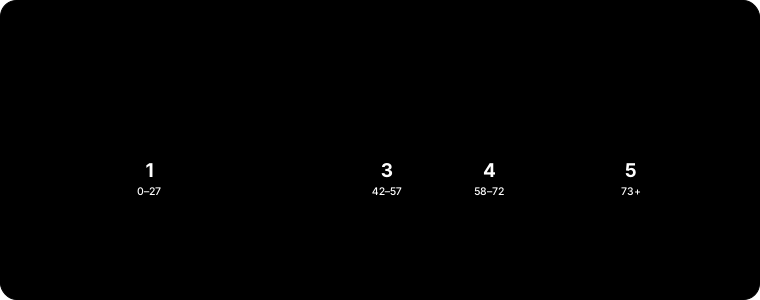
The College Board uses a process called equating to keep scores comparable across years, so the composite needed for each grade drifts slightly with exam difficulty. If your teacher curves differently, adjust the thresholds in the calculator — the same idea powers our Grade Curve Calculator.
What Is a Good AP Chemistry Score?
On the AP scale, 3 = qualified, 4 = well qualified, and 5 = extremely well qualified; a 1 or 2 earns no recommendation for credit. A score of 3 or higher is what most people mean by “passing,” though that word is not official.
So is a 3 good? It is a solid, credit-eligible result at many colleges and sits right around the national average. A 4 or 5 is more competitive and more widely accepted for college credit or advanced placement. Whether a specific score earns credit depends entirely on the institution, so check its AP credit policy — and if you do earn credit, our study guides and GPA tools can help you plan the next step.

AP Chemistry Score Distribution and Trends (2024–2025)
How do your predicted results compare to everyone else? The official AP Chemistry score distributions show the exam is scored generously relative to its reputation. In 2025, roughly 168,833 students took the exam, about 77.9% scored a 3 or higher, and the mean score was near 3.36.

| Year | Mean score | % scoring 3+ |
|---|---|---|
| 2025 | ≈ 3.36 | 77.9% |
| 2024 | ≈ 3.31 | 75.6% |
What-If Mode: Points You Need to Reach Your Target Score
Working backward is often more useful than a single prediction. Use the targets below as a starting point, then fine-tune them in the calculator by dragging the sliders until the predicted score turns into your goal. Because multiple choice and free response are weighted equally, strength in one section can offset weakness in the other.

| Goal score | Approx. MCQ (of 60) | Approx. FRQ points (of 46) | Composite |
|---|---|---|---|
| 5 | 45–50 | 32–38 | ≈ 73+ |
| 4 | 37–42 | 25–30 | ≈ 58+ |
| 3 | 28–33 | 18–23 | ≈ 42+ |
How to Get a 5 on AP Chemistry
Multiple-choice strategy: pace yourself at roughly 90 seconds per question, eliminate wrong options, and — because there is no guessing penalty — answer every single question, even the ones you skip and come back to.
Free response: the three long questions reward full worked solutions, so show every step, include units, and attempt each part; the four short questions test focused skills like drawing a particle diagram or justifying a trend. Watch the task verbs (“Calculate,” “Justify,” “Determine,” “Explain”) — each asks for something specific.
Then self-score your practice FRQs against the published rubrics and feed the points back into this calculator to track progress. Studying for other sciences too? The same method works with our AP Bio Score Calculator and AP Physics 1 Score Calculator.
- Unit 1 — Atomic Structure and Properties
- Unit 2 — Compound Structure and Properties
- Unit 3 — Intermolecular Forces and Properties
- Unit 4 — Chemical Reactions
- Unit 5 — Kinetics
- Unit 6 — Thermodynamics
- Unit 7 — Equilibrium
- Unit 8 — Acids and Bases
- Unit 9 — Applications of Thermodynamics
How Accurate Is This AP Chem Score Calculator?
Score predictions from this tool are typically accurate to within about one point. They use the equal section weighting and recent-year cutoffs, both of which are stable, but the College Board keeps the exact scoring worksheet private and re-equates the exam every year. That means a borderline composite — say, right on a cutoff — could land either way depending on that year's curve. Use the estimate to plan and motivate, not as a guaranteed grade.
When Do AP Chemistry Scores Come Out?
Official AP scores are released each July in your College Board account, where you can view your 1–5 result and send it to colleges. Once you know your score, check each school’s AP credit policy and use our GPA calculator to see how any awarded credit affects your college GPA.
Explore More AP Score Calculators
Taking more than one AP this year? EduCalcDb has a matching predictor for each exam. Browse the full set of AP exam score calculators, or jump straight to the popular APUSH Score Calculator to plan your history exam the same way.
Many AP Chemistry students sit a calculus exam in the same year; the AP Calc AB Score Calculator and AP Calc BC Score Calculator cover both courses.
Building a full STEM schedule? Try the AP Physics C Mechanics Score Calculator or the AP Computer Science A Score Calculator.
Curious how AP Chemistry's curve compares with other subjects? See our AP score curves compared across every exam, the easiest and hardest AP exams ranked by real pass rates, and the full AP score distributions for every exam.
Frequently Asked Questions
How is the AP Chemistry exam scored?
The AP Chemistry exam has two equally weighted sections. Section I is 60 multiple-choice questions (50% of the score) and Section II is seven free-response questions worth 46 raw points — three long-answer questions (10 points each) and four short-answer questions (4 points each) — also 50%. Each section is scaled and combined into a composite out of 100, which converts to a 1–5 score. There is no penalty for wrong answers.
Is this an AP Chem calculator or an AP Chemistry score predictor?
Both names describe this tool. An AP chem calculator, an AP chem score predictor, an AP chemistry exam score calculator, a chem AP score calculator, and an AP chemistry calculator all point at the same thing — enter your multiple-choice and free-response points and it returns a weighted composite out of 100 plus a predicted 1–5 AP Chemistry score.
Is this an AP Chem grade calculator too?
Yes. An AP Chem grade calculator, an AP Chemistry exam calculator, and an AP Chem score calculator all describe the same tool — one that predicts your 1–5 AP score from your multiple-choice and free-response points. Whether you searched “chemistry ap score calculator” or “score calculator ap chemistry,” this AP Chemistry calculator returns the weighted composite and estimated score in one step.
What score do you need to get a 5 on AP Chemistry?
Roughly a 72–73+ composite out of 100 (about 70–75% of the available points). In practice that usually means answering about 45–50 of the 60 multiple-choice questions correctly and earning around 32–38 of the 46 free-response points. The exact cutoff shifts a little each year with the curve, so treat any calculator result as an estimate.
What is a passing score on AP Chemistry?
A 3, 4, or 5 is generally treated as passing. The College Board labels a 3 “qualified,” a 4 “well qualified,” and a 5 “extremely well qualified.” In 2025, about 77.9% of test-takers scored a 3 or higher. Note that “passing” is not an official College Board term, and college credit policies vary by school.
How accurate are AP Chemistry score calculators?
Usually within about one point. Calculators estimate your result using previous years’ curves and the 50/50 section weighting, but the College Board does not publish the official current scoring worksheet or the exact raw-score cutoffs, so every prediction is an unofficial projection rather than a guaranteed grade.
What percent of students get a 5 on AP Chemistry?
In 2025, about 17.9% of the roughly 168,833 test-takers scored a 5. The full 2025 distribution was 5: 17.9%, 4: 28.6%, 3: 31.4%, 2: 15.9%, and 1: 6.2%, with a mean score near 3.36.
Is AP Chemistry curved?
Yes. The College Board adjusts the composite-to-score cutoffs each year through a process called equating, which accounts for small differences in exam difficulty and keeps the 1–5 scale consistent from year to year. That is why the cutoffs move slightly and why a calculator can only estimate your score.
Can I use a calculator on the AP Chemistry exam?
You may use a four-function, scientific, or graphing calculator only on Section II (free response), not on Section I (multiple choice). A periodic table and a sheet of commonly used equations and constants are provided and may be used on both sections. Some study blogs incorrectly claim calculators are allowed throughout — they are not.
Does AP Chemistry give college credit?
Often, but it depends on the institution. Many colleges grant credit or placement for a 4 or 5, and a large number also accept a 3. Always check your target college’s AP credit policy before assuming a score will count, and use a GPA calculator to see how the credit affects your standing.
When do AP Chemistry scores come out?
AP scores, including AP Chemistry, are typically released in July through your College Board account. From there you can view your 1–5 score and choose which colleges to send it to.