AP Psych Calculator: Your AP Psychology Score, Instantly
Academic examsEstimate an AP Psychology composite using MCQ and FRQ sections.
Score thresholds
Editable estimated composite cutoffs. Official AP raw-score cutoffs are not published and can shift by exam year.
The AP Psychology score calculator above turns your multiple-choice and free-response results into a predicted 1–5 score. Enter how many of the 75 multiple-choice questions you expect to get right and your projected points on the Article Analysis Question (AAQ) and Evidence-Based Question (EBQ), and this AP Psych calculator weights each section, builds a composite out of 100, and estimates your AP score — fully updated for the 2025 exam redesign.
How the AP Psychology Score Calculator Works
The AP Psychology score calculator above turns your raw performance on the two exam sections into a predicted 1–5 score in seconds. You enter how many of the 75 multiple-choice questions you expect to answer correctly and how many points you expect to earn on the two free-response questions — the Article Analysis Question (AAQ) and the Evidence-Based Question (EBQ) — and this AP Psych calculator weights each section, sums them into a composite score out of 100, and maps that composite to a predicted 1–5 AP score.
Because it is built around the exact structure of the redesigned exam, this AP Psychology score predictor is far more useful than a generic percentage grader. It shows you not just a number but where you stand relative to the score cutoffs, so you can plan the rest of your studying around a concrete target.

Inputs: your projected multiple-choice score (0–75) and your projected free-response points (0–14, combining the 7-point AAQ and 7-point EBQ). Outputs: a weighted composite score out of 100 and a predicted AP score of 1, 2, 3, 4, or 5. Adjust the sliders to run instant “what-if” scenarios and see how many more points move you into the next band.
How the AP Psychology Exam Is Scored
AP Psychology was redesigned effective the May 2025 administration, and the change matters for scoring. The old exam had 100 multiple-choice questions and two open-ended free-response prompts. The current exam, delivered digitally in the Bluebook app, has 75 multiple-choice questions (each with four answer choices) and two source-based free-response tasks: the Article Analysis Question (AAQ) and the Evidence-Based Question (EBQ). If you studied from a pre-2025 review book, confirm you are practicing the new format — the question types are genuinely different.
Section I (multiple choice) counts for roughly 66.7% of the exam. Section II counts for the remaining ~33.3%, split evenly between the AAQ and the EBQ (about 16.65% each). You can read the official structure on the College Board AP Psychology exam page and the details of the redesign on the AP Central exam revisions page.
| Section | Questions | Time | Weight | Raw points |
|---|---|---|---|---|
| Section I: Multiple Choice | 75 questions | 90 minutes | ~66.7% | 75 |
| Section II: Article Analysis (AAQ) | 1 prompt, parts A–F | 25 minutes | ~16.65% | 7 |
| Section II: Evidence-Based (EBQ) | 1 prompt | 45 minutes | ~16.65% | 7 |
The Composite Score Formula (Shown Transparently)
To combine the two sections, the calculator scales each raw score to its weight and adds them into a composite out of 100. In plain terms:
Composite = (MCQ ÷ 75 × 66.7) + (FRQ points ÷ 14 × 33.3)
Worked example: Suppose you get 60 of 75 multiple-choice questions right and earn 11 of 14 free-response points. Multiple choice contributes 60 ÷ 75 × 66.7 = 53.4. Free response contributes 11 ÷ 14 × 33.3 = 26.2. Your composite is about 79.5 — comfortably inside the range that predicts a 5. Nudge the multiple-choice down to 50 and the composite falls near 70, which lands in the 4 band. Small shifts on either section clearly change the outcome, which is exactly what the sliders let you explore.
College Board does not publish the exact raw-score-to-1–5 conversion, and the precise section weighting is not officially released either. The cutoffs used here are informed estimates that College Board re-calibrates every year through a process called equating. Treat your predicted score as a study guide, not a guarantee.
AP Psychology Score Cutoffs
The calculator maps your composite (out of 100) to a predicted AP score using the estimated score cutoffs below. A higher composite means a higher predicted score; the bands show roughly how much room you have before slipping into a lower score.
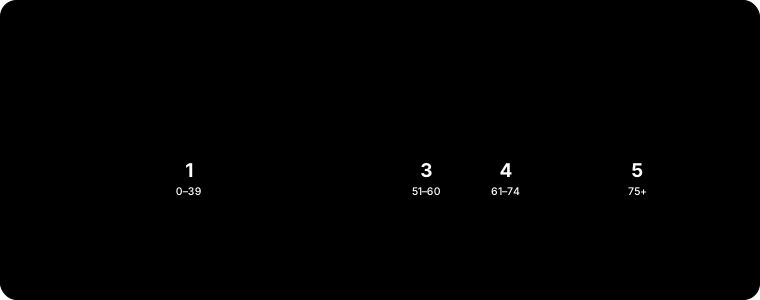
AP scores are equated so that a 4 means the same thing from one year to the next, even when one form is slightly harder. That means the real cutoff for each score drifts a few points annually. Aim comfortably above a threshold rather than right on it so a tough form doesn’t cost you a point.
What Is a Good AP Psychology Score?
AP scores run from 1 to 5. College Board describes a 5 as “extremely well qualified,” a 4 as “well qualified,” a 3 as “qualified,” a 2 as “possibly qualified,” and a 1 as “no recommendation.” A score of 3 or higher is commonly called “passing,” but note that “passing” is not an official College Board term — the accurate framing is that a 3+ is considered “qualified” and is the level at which many colleges grant credit or placement.
For AP Psychology specifically, a 4 or 5 is a strong result that many selective universities reward with credit. A 3 is respectable and widely accepted at large public universities, though some competitive schools require a 4 or 5. Always check the specific credit policy of the college you are targeting, because psychology credit rules vary widely.

AP Psychology Score Distribution and Trends
The 2025 exam was the first administration of the redesigned format, and the results shifted markedly from 2024. In 2025, about 70.5% of the 334,960 test-takers scored 3 or higher, with a mean score of 3.20 — a notable rebound from 2024, which had an unusually high share of 1s (26.5%). The chart below shows the official 2025 AP Psychology score distribution; you can verify these figures on the College Board AP Psychology score distributions page.

| Year | Mean score | % scoring 3+ |
|---|---|---|
| 2025 (redesigned exam) | 3.20 | 70.5% |
| 2024 (previous format) | 2.97 | 61.7% |
What-If Mode: Points You Need to Reach Your Target Score
Use the calculator’s sliders to reverse-engineer your goal. The table below shows one balanced path to each target — roughly equal effort across both sections. There are many combinations that hit the same composite; a strong multiple-choice section can offset weaker free-response points and vice versa.

| Goal score | Approx. MCQ (of 75) | Approx. FRQ points (of 14) | Composite (of 100) |
|---|---|---|---|
| 5 | ~56 | ~11 | ~76 |
| 4 | ~46 | ~9 | ~62 |
| 3 | ~39 | ~7 | ~51 |
How to Get a 5 on AP Psychology
Scoring a 5 on the redesigned exam rewards two things: broad content mastery across the five units and fluency with the new source-based question types. On the multiple-choice section, speed and recall matter — 75 questions in 90 minutes is a comfortable pace only if the vocabulary is automatic. On the AAQ, practice reading a single research summary and answering parts A–F precisely: identify the research method, define operational variables, interpret basic statistics, name the ethical guideline, judge generalizability, and connect the finding to a concept. On the EBQ, you must state a defensible claim and support it with at least two of the three provided sources, tying each piece of evidence to a distinct psychological concept. The single most common EBQ mistake is describing a study without explicitly linking it to both your claim and a course term.
Build your review around the official units and science-practice skills below.
- Unit 1 — Biological Bases of Behavior: neurons, brain structures, sleep, sensation, consciousness
- Unit 2 — Cognition: memory, thinking, problem-solving, intelligence, language
- Unit 3 — Development and Learning: classical/operant conditioning, cognitive and social development
- Unit 4 — Social Psychology and Personality: attribution, conformity, personality theories, motivation and emotion
- Unit 5 — Mental and Physical Health: psychological disorders, therapies, stress and health
- Skill — Concept Application: apply psychological terms to real scenarios
- Skill — Research Methods & Design: identify methods, variables, and ethical guidelines
- Skill — Data Interpretation: read tables, graphs, and basic statistics from studies
How Accurate Is This AP Psychology Score Calculator?
This tool is a well-calibrated estimate, not an official predictor. Its accuracy depends on two things College Board does not publish: the exact raw-to-scaled conversion and the precise section weighting, both of which are re-set each year through statistical equating. The cutoffs here reflect historical patterns, so your predicted score should land within about one point of your real result if your practice scores are honest. Use it to gauge readiness and set targets, and consult the official AP scores and credit policy resources for what your score actually earns you.
When Do AP Psychology Scores Come Out?
AP scores are released each year in July. Most students can view their scores online in early-to-mid July through their College Board account, with exact dates announced by College Board each spring. Until then, this AP Psychology score predictor is the fastest way to estimate where you are likely to land.
Explore More AP Score Calculators
Taking more than one AP exam this year? Try our other predictors, all built on the same transparent method: the AP Bio Score Calculator, AP Chem Score Calculator, APUSH Score Calculator, and AP Physics 1 Score Calculator. Browse the full collection of AP score calculators, or plan your semester with our GPA Calculator and read study guides on the blog.
Rounding out the social sciences? The AP Micro Score Calculator and the AP Human Geography Score Calculator use the same prediction model.
Curious how AP Psychology's curve compares with other subjects? See our AP score curves compared across every exam, the easiest and hardest AP exams ranked by real pass rates, and the full AP score distributions for every exam.
Frequently Asked Questions
Is the AP Psychology exam different now?
Yes. Starting with the May 2025 administration, AP Psychology was redesigned. Section I now has 75 multiple-choice questions (with four answer choices instead of five, down from 100 questions), and Section II replaced the old open-ended free-response prompts with two source-based tasks: the Article Analysis Question (AAQ) and the Evidence-Based Question (EBQ). The exam is delivered digitally in the Bluebook app.
Is this an AP Psych calculator or an AP Psychology exam calculator?
Both — an AP Psych calculator, a psych calculator, and an AP Psychology exam calculator all describe this tool. Whether you searched “ap psychology score calculator,” “ap psych calculator,” or “ap psychology grade calculator,” it turns your multiple-choice and AAQ/EBQ points into a predicted 1–5 AP Psychology score.
What is a passing score on AP Psychology?
A score of 3 or higher is commonly called passing, though College Board does not officially use the word passing. A 3 is labeled qualified, a 4 is well qualified, and a 5 is extremely well qualified. In 2025, about 70.5% of test-takers scored 3 or higher. Whether a 3 earns college credit depends on each institution's policy.
What are the AAQ and EBQ on AP Psychology?
The Article Analysis Question (AAQ) gives you one summarized peer-reviewed study and asks you to analyze it in parts A through F, covering research method, operational variables, statistics, ethics, generalizability, and connection to a concept. The Evidence-Based Question (EBQ) gives you three study summaries and asks you to make a claim and support it using at least two of the three sources. Each is worth 7 points.
How many questions do I need to get right to score a 5?
There is no single fixed number because College Board equates the exam each year, but a balanced path to a 5 is roughly 56 of 75 multiple-choice questions plus about 11 of 14 free-response points, which produces a composite near 76. Strong performance on one section can offset a weaker one. Use the calculator's sliders to test your own combinations.
Is the AP Psychology exam curved?
Not curved in the classroom sense. Instead, College Board uses statistical equating so that a given score reflects the same level of achievement regardless of which form you took or how difficult it was. This means the raw-score cutoffs for each 1 through 5 shift slightly every year.
Does a 3 on AP Psychology get you college credit?
Sometimes. Many large public universities award credit or placement for a 3, while more selective schools often require a 4 or 5. Psychology credit policies vary widely, so check the specific college's AP credit chart. A 4 or 5 is accepted more broadly.
When do AP Psychology scores come out?
AP scores are released in July. Most students can view their AP Psychology score online through their College Board account in early-to-mid July, with the exact release dates announced by College Board each spring.
How accurate is this AP Psychology score calculator?
It is a close estimate rather than an official result. Because College Board does not publish the exact raw-to-scaled conversion or the precise section weighting, the cutoffs are informed approximations updated to reflect the redesigned exam. If your practice scores are honest, your prediction should land within about one point of your actual score.