AP CSP Score Calculator: MCQ Plus Create Task, Scored
Academic examsEstimate an AP Computer Science Principles composite from multiple-choice and Create performance task rubric rows.
Score thresholds
Editable estimated composite cutoffs. Official AP raw-score cutoffs are not published and can shift by exam year.
The AP CSP score calculator above turns the only two numbers that matter — how many of the 70 end-of-course multiple-choice questions you answered correctly, and how many of the six Create performance task rubric rows you earned — into a predicted 1–5 AP Computer Science Principles score. Because College Board weights this exam 70% multiple choice and 30% Create task, and Section I contains exactly 70 questions, the arithmetic is the cleanest in the entire AP catalogue: your composite score out of 100 is simply your raw multiple-choice count plus 5 points for every rubric row. Below we explain why that tidy formula makes AP CSP predictions unusually coarse, why a flawless multiple-choice performance still cannot reach a 4 on its own, and what the latest official score distribution says about your real odds.
How the AP CSP Score Calculator Works
The AP CSP score calculator asks for the only two things you can actually measure: your raw multiple-choice count out of 70, and the number of Create performance task rubric rows you expect to earn out of 6. It applies the official section weighting — 70% for Section I, 30% for Section II — and returns a composite out of 100, a predicted AP score of 1 to 5, and the distance to the next cutoff.
Most AP calculators have to scale raw points onto a weighted scale using awkward decimals. AP CSP does not, and this is the quiet reason it is worth understanding rather than just using. Section I has exactly 70 questions and is worth exactly 70% of your score, so one correct multiple-choice question is worth precisely one composite point. Section II is worth 30% and is scored on exactly six rubric rows that are each worth 0 or 1, so one rubric row is worth precisely five composite points. The entire model is composite = multiple-choice correct + (rubric rows × 5). It is exact, not an approximation.
That cleanliness has a sharp edge. Thirty percent of your composite moves in 5-point jumps, and our estimated 4 band is only 11 points wide (72–82) while the 3 band is 14 points wide (58–71). A single rubric row is therefore worth nearly half the width of our entire estimated 4 band. Combined with cutoffs that genuinely drift 2–4 composite points from year to year, this means one misjudged row can flip your prediction from a 4 to a 3. We would rather tell you that plainly than dress up a coarse estimate as a precise one — AP CSP predictions are inherently blunter than the ones our other AP tools produce.
Some students search for an "apcsp calculator" written as one word, and most of what they find hard-codes a single curve and hides the maths. Here every field is editable, including the cutoffs themselves, and there is a use case unique to this exam: because the Create task is submitted in late April, before you sit the end-of-course exam, 30 of your 100 composite points are already locked in on exam morning. Enter your honest rubric estimate once and the calculator tells you exactly how many of the remaining 70 points you still need.

| Question | Section | Max | Weight |
|---|---|---|---|
| Multiple Choice Correct | Multiple Choice | 70 | |
| Create Task rubric rows earned | Create Performance Task | 6 |
Inputs: your raw end-of-course multiple-choice score out of 70 (all 70 questions count equally, including the 8 all-or-nothing multi-select items), plus the number of Create performance task rubric rows you earned, from 0 to 6. Outputs: a composite score out of 100, a predicted AP score of 1, 2, 3, 4 or 5, and how many points separate you from the next band. Because the cutoffs are editable, you can also stress-test your result against a stricter curve — which on this exam you genuinely should.
- Count your raw multiple-choice score out of 70. No conversion is needed: every question is worth exactly one composite point.
- Score the 8 multi-select questions strictly. These items ask you to choose 2 answers and they are all-or-nothing — one correct selection and one wrong one earns zero, not a half.
- Estimate your Create performance task rows honestly against the official scoring guidelines. Each of the six rows is a binary 0 or 1 with no partial credit inside it, and each is worth 5 composite points.
- Read off the composite out of 100 and the predicted 1–5, then note how far you sit from the next cutoff.
- Re-run the numbers with one rubric row removed. If the prediction drops a whole band — which on this exam it often does — treat the lower score as your realistic planning number, not the higher one.
How the AP Computer Science Principles Exam Is Scored
AP Computer Science Principles is scored unlike any other AP exam, and this is the single most important thing to understand before you trust any prediction. There is no conventional free-response section on exam day. Section I is the end-of-course multiple-choice test: 70 questions in 120 minutes, worth 70% of your score. Section II is the Create performance task, worth the other 30% — a program, a video of that program running, and written responses that you build during class and submit before the exam, with the deadline falling in late April (April 30 for the 2026 administration). By the time you walk into the exam room, nearly a third of your grade has already been decided. You can confirm the format on the official College Board AP Computer Science Principles course page.
Section I is not 70 identical questions either. It breaks into 57 standard single-select questions, 5 single-select questions tied to a reading passage about a computing innovation that you have never seen before, and 8 multi-select questions that instruct you to choose 2 answers. Those 8 multi-select items are strictly all-or-nothing: both correct options or no point. They represent 8 composite points — more than a full letter band's worth of movement — and most third-party practice sets badly under-represent them. There is no guessing penalty anywhere on the exam, and 120 minutes across 70 questions gives you about 1 minute 43 seconds each, which is comfortable by AP standards.
Section II is scored on exactly six rubric rows, each worth 0 or 1 point. There is no partial credit within a row: a reader either sees everything the row demands or awards nothing. The rows cover things like the program's design and purpose, its handling of data, the student-developed procedure and its algorithm, and testing — but check the current official Create performance task scoring guidelines on AP Central for the exact wording, because College Board has revised these rows before and the precise requirements are what readers apply.
One consequence deserves its own sentence. College Board states that "Students who take the end-of-course exam will receive a score even if they do not submit the Create performance task." You are not disqualified for skipping it — you simply forfeit 30 composite points. That makes the Create task mathematically decisive in a way no free-response section on any other AP exam is.
| Component | Items | Timing | Weight | Composite points |
|---|---|---|---|---|
| Section I — End-of-course multiple choice | 70 questions | 120 min on exam day | 70% | 70 |
| Standard single-select | 57 | Part of the 120 min | 57% | 57 |
| Single-select on the computing-innovation passage | 5 | Part of the 120 min | 5% | 5 |
| Multi-select — choose 2 answers | 8 | Part of the 120 min | 8% | 8 |
| Section II — Create performance task | Program, video and written responses | Built in class, submitted by the late-April deadline | 30% | 30 |
| Each Create rubric row | 6 rows, scored 0 or 1 | Not timed | 5% each | 5 |
| Total | 70 questions + 1 performance task | 120 min exam plus in-class work | 100% | 100 |
The AP CSP Composite Score Formula
The formula is short enough to do in your head: composite = multiple-choice correct + (Create rubric rows × 5). That produces a number from 0 to 100, which the score bands convert into a 1–5. No weighting factors, no rounding, no scaled-score table.
Worked example. Suppose you answer 52 of the 70 multiple-choice questions correctly and earn 4 of the 6 Create rubric rows. Your multiple-choice contribution is 52. Your Create contribution is 4 × 5 = 20. Your composite is 52 + 20 = 72 out of 100, which on our estimated bands is a 4 — sitting exactly on the floor of that band, with zero margin.
Now watch how fragile that is. If a reader disagrees with you on one row and awards 3 instead of 4, your composite becomes 52 + 15 = 67, which is a 3. If you earn one extra row instead, 52 + 25 = 77 puts you comfortably mid-4. And to reach the 83 needed for a 5, the route depends entirely on the Create task: with 4 rows you would need 63 of 70 multiple-choice correct (11 more questions), with 5 rows you would need 58 (6 more), and with all 6 rows you would need only 53 — a single question more than you already have. One rubric row is worth five multiple-choice questions, which is why the Create task is the highest-leverage thing on this exam.
The most striking property of this formula is the ceiling it imposes. A student who answers every single multiple-choice question correctly — a perfect 70/70 — but submits no Create task scores 70 + 0 = 70, which under these estimates is a 3, not a 4. Add one rubric row and 75 becomes a 4; add two and 80 is still a 4. A 5 is mathematically impossible with fewer than three rubric rows, because 70 + 10 = 80 is the absolute maximum available at two rows. Even at three rows you would need 68 of 70 correct, missing at most two questions all exam. No amount of multiple-choice excellence rescues an unsubmitted or badly built Create task.
AP CSP Score Cutoffs: Honest Estimates, Not Official Numbers
College Board has never published a raw-score-to-AP-score conversion for AP Computer Science Principles, and it never will. The exam is statistically equated every year so that a 4 in one year means the same thing as a 4 in another, which necessarily means the raw-score boundary moves. Anyone showing you an "official" AP CSP cutoff chart is showing you an estimate with a confident font.
Ours are estimates too, and here they are in the open: 5 = 83+, 4 = 72–82, 3 = 58–71, 2 = 45–57, 1 = 0–44, all out of 100. Real cutoffs typically move about 2–4 composite points per year in either direction, so a boundary we place at 83 could realistically sit anywhere from about 79 to 87 in a given administration.
Stack that uncertainty on top of the 5-point granularity of the Create task and you get the honest headline of this page: AP CSP predictions are coarser than our other AP calculators, and no tool on the internet can fix that. A prediction 8 points inside a band is trustworthy. A prediction within about 4 points of a boundary — which describes an enormous share of real results, because 30 of your points arrive in 5-point lumps — is a genuine coin flip. Use the calculator to find out which questions and which rubric rows would move you, not to pin down a number you can quote to your family in June.
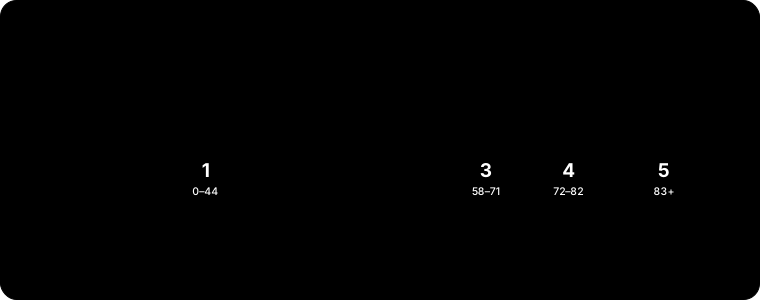
College Board does not release raw-score cutoffs for AP Computer Science Principles and re-equates the exam annually, so the true boundaries drift roughly 2–4 composite points per year. The bands built into this tool are our editable estimates, not official data. Because a single Create rubric row swings your composite by 5 points, a change of one row can flip the predicted AP score outright. Treat any result within about 4 points of a cutoff as genuinely uncertain, and aim for the middle of your target band rather than its edge.
What Is a Good AP CSP Score?
AP scores run from 1 to 5. College Board describes a 3 as "qualified", a 4 as "well qualified" and a 5 as "extremely well qualified"; a 2 is "possibly qualified" and a 1 carries no recommendation. "Passing" is not an official term — the accurate phrase is a qualifying score, meaning a 3 or higher.
On this exam the raw numbers reframe what "good" means. In 2025, the most recent complete official year, the mean AP CSP score was 2.87 and only 10.7% of students earned a 5 across 175,174 test-takers. Fewer than one in nine reached the top band, and more students scored a 1 than scored a 5. A 4 on AP CSP is a genuinely strong result, not a consolation prize, and a 3 puts you above the mean.
For college credit, the practical picture is that many institutions treat AP CSP as an introductory or non-majors computing course rather than as the first course in a computer science major — the major sequence more often maps to AP Computer Science A. Some departments grant elective credit, some grant placement without credit, and some grant nothing at either. Check the computer science department's own published policy for the specific score, because university-wide credit tables frequently disagree with what the CS department actually accepts.

AP CSP Score Distribution: What the Data Shows
The preliminary 2026 AP Computer Science Principles distribution reads: 10% earned a 5, 23% earned a 4, 30% earned a 3, 21% earned a 2 and 16% earned a 1, with 63% scoring a 3 or higher. These are preliminary figures reported to the nearest whole percent, and College Board has not yet published a test-taker count or a mean score for 2026.
The most recent complete official year is 2025, published on the AP Students score-distributions page: 10.7% earned a 5, 19.9% a 4, 31.2% a 3, 21.4% a 2 and 16.8% a 1, for a 61.9% qualifying rate across 175,174 test-takers and a mean of 2.87. You can verify every subject against the official AP score distributions published by College Board. Year over year the exam is stable: the share of 5s barely moved (10.7% to 10%) while 4s picked up about three points, nudging the qualifying rate from 61.9% to 63%.
Two features of this shape are worth internalizing before you read your own prediction. First, the modal outcome is a 3 — roughly three in ten students land there, more than any other score — so a calculator result of 3 is the single most likely outcome, not a warning sign. Second, in both years more students scored a 1 than scored a 5. That asymmetry is what a mandatory, submitted-in-advance performance task does to a distribution: students who never submit a working Create task collect zero of its 30 points, and no multiple-choice performance can pull them back.

| Score | 2026 (preliminary) | 2025 (official) |
|---|---|---|
| 5 | 10% | 10.7% |
| 4 | 23% | 19.9% |
| 3 | 30% | 31.2% |
| 2 | 21% | 21.4% |
| 1 | 16% | 16.8% |
| 3 or higher | 63% | 61.9% |
| Mean score | Not published | 2.87 |
| Test-takers | Not published | 175,174 |
What-If Mode: The Points You Need for a 3, 4 or 5
Because the composite is a plain sum, you can run the calculator backwards from any target. The table below fixes your Create performance task result and solves for the multiple-choice score you would need. Read the columns as three different students: one who nailed all six rubric rows, one who earned four, and one who earned two.
The pattern is stark. At six rows, a 5 needs 53 of 70 multiple-choice questions — you can miss 17. At four rows, the same 5 needs 63, so you can miss only 7. At two rows a 5 is arithmetically impossible: the maximum reachable composite is 70 + 10 = 80, which is a 4. And with zero rows, the ceiling is 70, which is a 3. Every one of these thresholds is measured against our unofficial estimated cutoffs, so treat them as targets to clear by a margin rather than numbers to land on exactly.
| Target score | Composite needed | With 6 of 6 Create rows (+30) | With 4 of 6 Create rows (+20) | With 2 of 6 Create rows (+10) |
|---|---|---|---|---|
| 5 | 83 | 53 of 70 — miss up to 17 | 63 of 70 — miss up to 7 | Not possible — ceiling is 80 |
| 4 | 72 | 42 of 70 — miss up to 28 | 52 of 70 — miss up to 18 | 62 of 70 — miss up to 8 |
| 3 | 58 | 28 of 70 — miss up to 42 | 38 of 70 — miss up to 32 | 48 of 70 — miss up to 22 |
| 2 | 45 | 15 of 70 | 25 of 70 | 35 of 70 |

How to Get a 5 on AP CSP
Start where the leverage is. One rubric row equals five multiple-choice questions, so an hour spent tightening your Create submission against the official scoring guidelines is worth roughly five hours of multiple-choice drilling. Print the guidelines, read each row as a checklist of things a reader must be able to point at in your program and written responses, and then make each of those things impossible to miss — name it explicitly in your response and cite the exact code segment. Readers do not award a row for work they had to infer.
Second, treat the 8 multi-select questions as their own study category. They are all-or-nothing, so your effective accuracy on them is far lower than your accuracy on ordinary questions, and 8 composite points is more than the width of the gap between many students' predicted and target scores. Practice deliberately eliminating four options down to exactly two rather than picking the single best-looking answer.
Third, rehearse the computing-innovation passage under time. Five questions hang on a text you have never seen, and it is the one place on this exam where reading discipline beats content knowledge. Skim the questions first, then read for the specific claims they ask about.
Fourth, answer everything. There is no guessing penalty, so a blank is strictly worse than a guess — on a 4-option question a blind guess is worth about 0.25 composite points, and a blank is worth exactly zero. Finally, calibrate against real released materials rather than your own generosity, and if you are prepping several subjects, our full library of AP score calculators lets you run the same honesty check on each one.
- Big Idea 1 — Creative Development: collaboration, program design and development processes, and systematic debugging
- Big Idea 2 — Data: binary representation, lossy vs lossless compression, metadata, and drawing defensible conclusions from data
- Big Idea 3 — Algorithms and Programming: variables, lists, procedures, iteration, selection, simulations, and reasonable vs unreasonable running time
- Big Idea 4 — Computer Systems and Networks: packets, routing, fault tolerance, redundancy, and parallel and distributed computing
- Big Idea 5 — Impact of Computing: beneficial and harmful effects, the digital divide, bias, crowdsourcing, legal and ethical concerns, and safe computing
- Drill the 8 multi-select "choose 2 answers" items specifically — they are all-or-nothing and most third-party practice sets under-represent them
- Practice the computing-innovation passage under time, since 5 of the 70 questions depend on a text you will read cold
- Confirm all three components of your Create performance task are marked as final in the AP Digital Portfolio before the late-April deadline — an unsubmitted task costs all 30 composite points
- Have a classmate or teacher score your Create submission row by row against the official scoring guidelines, because self-scoring is where nearly all prediction error on this exam comes from
- Answer every multiple-choice question — there is no guessing penalty, so a blank can only cost you
When Do AP CSP Scores Come Out?
AP scores are released in early July. For the 2026 administration, scores went live on Monday, July 6, 2026 at scores.collegeboard.org, viewable with the same College Board account you used to register. AP Computer Science Principles is part of the standard July release wave and is not staggered onto its own schedule, and your Create performance task score is folded into the single 1–5 you see — you do not receive a separate rubric breakdown.
That leaves a two-month gap between the exam and the release where your own estimate is the only signal you have, which is exactly what this AP CSP score calculator is for. Enter your multiple-choice count and your honest rubric-row estimate and you will usually land within one band of the real result. Just remember the caveat that defines this exam: because your Create rows are a self-assessment worth 5 composite points each, the honesty of that single input matters more here than on any other AP calculator we publish.
Explore More AP Score Calculators
The first stop for most CSP students is the other computer science exam. Our AP CSA Score Calculator covers AP Computer Science A, and the two courses are far less similar than their names suggest. AP CSP is broad, conceptual and language-agnostic — data, networks, algorithms in the abstract, and the societal impact of computing, with a program you write in whatever language your class uses. AP Computer Science A is a Java programming course, assessed with a conventional multiple-choice section plus four free-response questions where you write real Java by hand. The scoring models are different too, so do not use this page's cutoffs for CSA or vice versa.
Sitting other exams this year? Our directory of AP score calculators covers the subjects students most often stack alongside computer science: the AP Stats Score Calculator is the natural quantitative pairing, AP Calculus AB and AP Physics 1 cover the STEM sequence, and AP Lang handles the writing requirement almost every schedule includes. If your school curves classroom grades before reporting them, the grade curve calculator converts a curved score back to the raw percentage you should be feeding into these tools, and our blog digs further into AP scoring mechanics, curves and exam-day tactics.
Curious how AP Computer Science Principles's curve compares with other subjects? See our AP score curves compared across every exam, the easiest and hardest AP exams ranked by real pass rates, and the full AP score distributions for every exam.
Frequently Asked Questions
Is the AP CSP score calculator accurate?
The composite is exact; the 1–5 prediction is an estimate. The 70% / 30% section weighting is official, and because Section I has exactly 70 questions and Section II has exactly six binary rubric rows, the composite arithmetic — multiple-choice correct plus 5 points per row — involves no approximation at all. The uncertainty lives entirely in the cutoffs. College Board has never published raw-score cutoffs for AP CSP and re-equates the exam every year, so no calculator anywhere has the real boundaries; ours are editable estimates that we state openly. Be aware that AP CSP predictions are inherently coarser than our other AP tools: with 30 points arriving in 5-point lumps and cutoffs drifting 2–4 points a year, one misjudged rubric row can flip your predicted score outright.
Is this AP CSP calculator the same as an AP comp sci principles score calculator?
Yes — the same tool under different names. Whether you searched for an "ap csp calculator", an "ap comp sci principles score calculator" or an "apcsp calculator", this page does one job: it converts your raw end-of-course multiple-choice score and your Create performance task rubric rows into a predicted 1–5 using the official 70/30 weighting. What it will not do is help you during the exam itself — AP CSP is a computing exam, not a computation exam, and a handheld calculator is not part of your prep for it.
What is a passing score on AP CSP?
"Passing" is not an official College Board term; the correct phrase is a qualifying score, meaning a 3 or higher. In 2026, 63% of AP Computer Science Principles students earned a 3 or higher on preliminary figures, and in 2025 the official figure was 61.9% across 175,174 test-takers with a mean score of 2.87. Whether a 3 earns you college credit is a separate question — many computer science departments want a 4 or 5, or credit AP Computer Science A instead.
How is the AP CSP exam scored?
Unlike every other AP exam, there is no free-response section on exam day. Section I is 70 multiple-choice questions in 120 minutes and is worth 70% of your score — 57 standard single-select items, 5 tied to a reading passage about a computing innovation, and 8 all-or-nothing multi-select items where you choose 2 answers. Section II is the Create performance task, worth 30%: a program, a video and written responses that you develop in class and submit by the late-April deadline, scored on six rubric rows that are each worth 0 or 1. Because Section I has exactly 70 questions, the composite out of 100 is simply your multiple-choice count plus 5 points per rubric row.
Can I still get an AP score if I do not submit the Create performance task?
Yes. College Board states that "Students who take the end-of-course exam will receive a score even if they do not submit the Create performance task." You are not disqualified — you just forfeit all 30 of the Create task's composite points. The consequence is severe and easy to underestimate: a student who answers every single multiple-choice question correctly, a perfect 70 out of 70, tops out at a composite of 70, which on our estimated cutoffs is a 3, not a 4. A 5 becomes mathematically impossible below three rubric rows.
How many multiple-choice questions can I miss and still get a 5 on AP CSP?
It depends entirely on your Create task, because the two sections trade off. Against our estimated cutoff of 83, earning all 6 rubric rows means you need 53 of 70 correct and can miss 17. With 5 rows you need 58 and can miss 12. With 4 rows you need 63 and can miss only 7. With 3 rows you need 68 and can miss just 2. With 2 rows or fewer, a 5 is impossible — the ceiling is 80. These are estimates against unofficial cutoffs, so leave yourself a margin.
What is the AP CSP score distribution?
Preliminary 2026 figures: 10% earned a 5, 23% a 4, 30% a 3, 21% a 2 and 16% a 1, with 63% scoring 3 or higher. No mean or test-taker count has been published for 2026 yet. The most recent complete official year is 2025, from the College Board AP Students score-distributions page: 10.7% earned a 5, 19.9% a 4, 31.2% a 3, 21.4% a 2 and 16.8% a 1 — a 61.9% qualifying rate across 175,174 students with a mean of 2.87. In both years, more students scored a 1 than scored a 5.
What is the difference between AP CSP and AP Computer Science A?
AP Computer Science Principles is broad, conceptual and language-agnostic: data representation, networks, algorithms in the abstract, and the impact of computing, assessed with a 70-question multiple-choice test plus a Create performance task you build in class. AP Computer Science A is a Java programming course, assessed with a multiple-choice section plus four handwritten free-response questions in Java. CSP is usually taken first and is often treated as an introductory or non-majors course, while CSA more often maps to the first course of a computer science major. The scoring models differ completely, so use our AP CSA Score Calculator for that exam rather than this page.
When do AP CSP scores come out?
Early July. The 2026 scores were released on Monday, July 6, 2026 at scores.collegeboard.org, and AP Computer Science Principles is part of the standard July release wave rather than a separate schedule. Sign in with the same College Board account you used to register for the exam. You will see a single 1–5 with no breakdown of how your Create performance task was scored, which is why estimating those rows yourself before release is the only visibility you get.