AP Physics C E&M Score Calculator: Your 1–5, Estimated
Academic examsEstimate an AP Physics C: Electricity and Magnetism composite from multiple-choice and free-response points.
Score thresholds
Editable estimated composite cutoffs. Official AP raw-score cutoffs are not published and can shift by exam year.
The AP Physics C E&M score calculator above converts two numbers you can count straight off a practice test — how many of the 40 multiple-choice questions you got right, and how many of the 40 free-response points you earned — into a weighted composite out of 100 and a predicted 1–5 AP score. Both sections are worth exactly 50%, so every step of the math is visible and every cutoff is editable. Below: the formula with real arithmetic, the 2026 score distribution, the exact raw totals you need for a 3, 4 or 5, and an explanation of why the E&M curve is consistently kinder than the Mechanics curve.
How the AP Physics C E&M Score Calculator Works
The calculator mirrors the real exam's structure with no hidden fudge factors. You enter your raw multiple-choice score (0–40) and your raw free-response points (0–40, spread across four questions worth 10, 12, 10 and 8 points). It scales each section to 50 points, adds them into a composite score out of 100, then maps that composite onto a predicted 1–5 using the estimated cutoffs shown further down the page.
What makes an AP Physics C electricity and magnetism calculator different from a generic AP score predictor is the curve it applies. E&M is taken by roughly 32,000 students a year — fewer than half the number who sit AP Physics C: Mechanics — and that self-selected group is one of the strongest cohorts in the AP program. Yet the exam is also widely regarded as the hardest of the AP physics papers: Gauss's law, Ampere's law, and the calculus of RC and LR circuits punish anyone who memorized formulas instead of learning to set up an integral. College Board equates for that difficulty, which is why the raw score needed for a 5 on E&M sits below the raw score needed for a 5 on Mechanics.
Because the tool is transparent rather than proprietary, you can move any cutoff to model a harsher or a kinder year. That matters more here than on most exams: E&M's small, high-performing population can make its curve harder to predict from one year to the next.

| Question | Section | Max | Weight |
|---|---|---|---|
| Multiple Choice Correct | Multiple Choice | 40 | |
| Q1: Mathematical Routines | Free Response | 10 | |
| Q2: Translation Between Representations | Free Response | 12 | |
| Q3: Experimental Design and Analysis | Free Response | 10 | |
| Q4: Qualitative/Quantitative Translation | Free Response | 8 |
Inputs: your multiple-choice raw score out of 40 and your free-response points out of 40 (Q1 = 10, Q2 = 12, Q3 = 10, Q4 = 8). Outputs: a weighted composite on a 0–100 scale, a predicted AP score of 1–5, and the number of points standing between you and the next band. There is no deduction for wrong or blank multiple-choice answers, so enter every question you guessed on.
How the AP Physics C: Electricity and Magnetism Exam Is Scored
AP Physics C: E&M is a standalone, calculus-based exam. It is scored separately from AP Physics C: Mechanics and produces its own 1–5 — many students sit both papers on the same day, and each gets its own score line and its own college credit decision. Per the official College Board exam page, the May 2025 and May 2026 administrations run 40 multiple-choice questions in 80 minutes (50% of the score) and 4 free-response questions in 100 minutes (the other 50%).
The free-response section is handwritten and totals 40 raw points, distributed identically to Mechanics: Q1 Mathematical Routines (10 points), Q2 Translation Between Representations (12 points), Q3 Experimental Design and Analysis (10 points), and Q4 Qualitative/Quantitative Translation (8 points). A graphing calculator is permitted on both sections and the table of equations and constants is supplied, so nothing on this exam rewards memorizing something you could look up.
One change to plan for: AP Central now publishes 42 multiple-choice questions in 85 minutes, with free response cut to 95 minutes, effective the May 2027 exam. This calculator uses the 40-question, 80-minute format — the format of every released practice exam currently in circulation and of the 2026 administration whose distribution we show below. If you are working from a 42-question form, convert before entering: multiply your MCQ percentage by 40. Scoring 30 out of 42 is (30 ÷ 42) × 40 = 28.6, so enter 28.6 (or 29 if you prefer whole numbers). The 50/50 weighting and the FRQ point structure are unchanged, so nothing else about the model needs adjusting.
| Section | Questions | Time | Weight | Raw points |
|---|---|---|---|---|
| I: Multiple Choice | 40 questions | 80 min | 50% | 40 |
| II: Free Response | 4 questions | 100 min | 50% | 40 (10 + 12 + 10 + 8) |
| Total | 44 items | 180 min | 100% | 80 |
| From May 2027 | 42 MCQ + 4 FRQ | 85 + 95 min | 50/50 | 42 MCQ + 40 FRQ |
The Composite Score Formula, With Real Arithmetic
Both sections carry 40 raw points and both are worth 50% of the score, which makes this the cleanest formula in the AP physics family:
Composite = (MCQ raw ÷ 40) × 50 + (FRQ raw ÷ 40) × 50
Because the two denominators are identical, it reduces to arithmetic you can do in your head: every raw point, multiple choice or free response, is worth exactly 1.25 composite points, and your composite is simply your total raw score out of 80 multiplied by 1.25. One multiple-choice question is worth precisely as much as one FRQ point. That is not true on AP Physics 1 or AP Calculus, and it should change how you triage the last ten minutes of each section.
Worked example. Suppose you get 24 of 40 multiple-choice questions right and earn 21 of 40 free-response points. The MCQ half contributes (24 ÷ 40) × 50 = 30.0. The FRQ half contributes (21 ÷ 40) × 50 = 26.25. Your composite is 30.0 + 26.25 = 56.25 out of 100, which lands in the 4 band (43–57) — but only 1.75 composite points below the estimated 5 cutoff of 58. Check it the fast way if you like: 24 + 21 = 45 raw points, and 45 × 1.25 = 56.25.
That 1.75-point gap is worth two raw points, since each one moves you 1.25. Find two more FRQ points — one correct setup line on the Gauss's law question, say — and the free-response half becomes (23 ÷ 40) × 50 = 28.75, for a composite of 30.0 + 28.75 = 58.75 and a predicted 5. Plenty of students who miss a 5 on E&M miss it by exactly that kind of margin: two or three points of partial credit left on the page, not a chapter of physics they never learned.
- Count your correct multiple-choice answers out of 40. Wrong answers cost nothing, so include everything you guessed.
- Add your free-response points using the official scoring guidelines: Q1 out of 10, Q2 out of 12, Q3 out of 10, Q4 out of 8.
- Add the two raw totals together for a single score out of 80.
- Multiply by 1.25. That is your composite out of 100 — identical to the two-term formula above, because 50 ÷ 40 = 1.25.
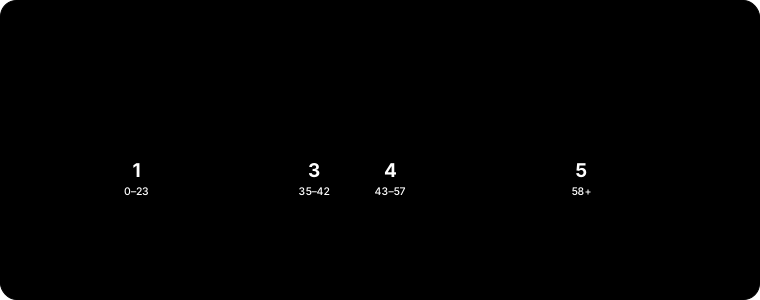
- Compare against the bands: 58+ predicts a 5, 43–57 a 4, 35–42 a 3, and 24–34 a 2.
AP Physics C E&M Score Cutoffs
The bands the AP Physics C E&M score calculator ships with are 5 = 58 or above, 4 = 43–57, 3 = 35–42, 2 = 24–34, 1 = 0–23, all out of a 100-point composite. Converted back into raw points out of 80, that works out to 47 raw points for a 5, 35 for a 4, 28 for a 3 and 20 for a 2 — 47 × 1.25 = 58.75 clears the 5 line, while 46 × 1.25 = 57.5 does not.
In percentage terms a 5 needs about 59% of the available points and a 3 needs exactly 35%. Those figures look absurdly low next to a classroom grading scale, and that is the single most important thing to internalize about this exam: a total that would be a failing grade in your physics class is a solid 4 nationally.
Notice too that these cutoffs sit a few points below the ones our AP Physics C Mechanics score calculator uses — at every single band. That is not a rounding artifact, it reflects the consistent historical pattern. E&M is the harder paper, students routinely run short of time on it, and equating compensates by lowering the raw-score bar. If you are scoring both halves of Physics C from the same afternoon, do not apply your Mechanics intuition to your E&M raw score. You are probably doing better than you think.
College Board has never published the raw-score-to-1–5 conversion for AP Physics C: Electricity and Magnetism, and it never will — the boundaries are re-set every year through statistical equating so that a 5 in 2026 means the same thing as a 5 in 2019. Every AP score calculator online, including this one, is working from reconstructed estimates. Ours are editable for exactly that reason: to model a brutal year, push the 5 cutoff up to 62 and see what it costs you.
What Is a Good AP Physics C E&M Score?
A 3 is College Board's official "qualified" threshold, and 75% of the 2026 cohort cleared it. But E&M is a credit exam taken almost entirely by people who intend to keep doing physics or engineering, so the audience that actually matters is a college registrar. Many engineering and physics departments require a 4 or 5 to grant credit for second-semester calculus-based physics; a 3 more often earns placement out of a course than credit toward the degree.
The honest benchmark: a 4 is a good score, a 5 is what a well-prepared student who finished the course should be aiming at, and a 3 is a genuine accomplishment given who takes this exam. Remember that this is not an average sample of high schoolers — it is roughly 32,000 students who chose the hardest physics course their school offers, and one in four of them still scored a 1 or a 2 in 2026 (17% earned a 2 and 8% earned a 1).
Two caveats worth acting on. First, AP credit policy for Physics C varies widely between institutions, so check the department's own table or the College Board credit policy search before deciding a 3 is enough. Second, plenty of students who earn E&M credit choose to retake the course anyway because the university version goes deeper. That is a legitimate choice, not a wasted exam.

AP Physics C E&M Score Distribution
In July 2026, Trevor Packer released the E&M distribution: 5 = 24%, 4 = 24%, 3 = 27%, 2 = 17%, 1 = 8% — that is 75% scoring a 3 or higher, from about 32,000 test-takers. Those are rounded preliminary figures; the full official table follows later in the year.
Compare that with the complete official 2025 figures: 5 = 25.2%, 4 = 23.7%, 3 = 24.1%, 2 = 17.8%, 1 = 9.2%, with 72.9% scoring 3 or higher, a mean score of 3.38, and 29,708 test-takers. Year over year the cohort grew by about 2,300 students, the 5 rate slipped just over a point, and the 3-or-higher rate rose by roughly two points. The distribution shifted toward the middle rather than the top.
The shape matters for how you read your predicted score. E&M's distribution is unusually flat — in 2026 the top three bands sat within three percentage points of each other, so students are spread evenly across 3, 4 and 5 rather than piled at the top as they are on a top-heavy exam like AP Calculus BC. Practically, that means the boundaries are crowded. A one- or two-point swing in partial credit relocates a lot of people, which is precisely why a calculator that shows you the distance to the next cutoff is more useful than one that just prints a number.

| AP score | 2026 | 2025 |
|---|---|---|
| 5 | 24% | 25.2% |
| 4 | 24% | 23.7% |
| 3 | 27% | 24.1% |
| 2 | 17% | 17.8% |
| 1 | 8% | 9.2% |
| 3 or higher | 75% | 72.9% |
| Test-takers | about 32,000 | 29,708 |
What-If Targets: The Raw Points You Need for a 3, 4 or 5
Because every raw point is worth 1.25 composite points, the estimated cutoffs translate cleanly into raw totals out of 80: 47 points for a 5, 35 for a 4, 28 for a 3 and 20 for a 2. The table below splits those totals by multiple-choice performance so you can read off how many free-response points you still need, and the AP Physics C E&M score calculator does the same arithmetic live as you change either input.
Use it in whichever direction helps. If you are two weeks out and consistently landing 24 on multiple choice, the table says a 5 requires 23 of 40 free-response points — about 58% partial credit. That is a specific, trainable target rather than a vague instruction to study harder.

| MCQ raw (of 40) | FRQ needed for 3 | FRQ needed for 4 | FRQ needed for 5 |
|---|---|---|---|
| 16 | 12 | 19 | 31 |
| 20 | 8 | 15 | 27 |
| 24 | 4 | 11 | 23 |
| 28 | 0 | 7 | 19 |
| 32 | 0 | 3 | 15 |
| 36 | 0 | 0 | 11 |
How to Study for AP Physics C E&M
The highest-leverage change most students make is switching the question from "can I solve this?" to "can I solve this in the time allowed?". E&M gives you two minutes per multiple-choice question (80 minutes for 40) and 25 minutes per free-response question (100 minutes for 4). Almost nobody underperforms on E&M because they cannot do the physics — they underperform because they spent nine minutes wrestling a Gauss's law setup and never started Q4, which is worth 8 raw points, or 10 composite points: more than five times the 1.75-point gap that separated a 4 from a 5 in the worked example above.
Second: calculus fluency. E&M is the most integral-heavy exam College Board offers. Continuous charge distributions, flux through awkward surfaces, work done moving a charge through a field, inductance, the transient behavior of RC and LR circuits — all of it comes down to setting up an integral or a differential equation. If your calculus is shaky the physics will not rescue you, which is why the strongest E&M students are usually the ones taking BC alongside. Our AP Calc BC score calculator is a reasonable proxy for whether your calculus is where it needs to be.
Third: learn the rubric, not just the content. The official scoring guidelines award points for stated relationships and correct setups, not only final answers. Writing the correct starting equation and defining your Gaussian surface, Amperian loop or coordinate system earns points even when the algebra collapses two lines later. Students who self-score practice exams without the guidelines in front of them systematically overestimate — which then makes any score prediction, including this one, look optimistic.
- Time-box each free-response question to 25 minutes, and start the 8-point Q4 no later than the 75-minute mark.
- Write a starting equation and define your surface, loop or coordinate system on every FRQ — setup points are awarded independently of the final answer.
- Answer all 40 multiple-choice questions. There is no penalty for a wrong answer and each is worth 1.25 composite points.
- Drill the four FRQ types by name: Mathematical Routines, Translation Between Representations, Experimental Design and Analysis, and Qualitative/Quantitative Translation.
- Rehearse the experimental-design question specifically — linearizing data and choosing what to plot is a separate skill from solving circuits.
- Keep the equations-and-constants sheet on the desk during every practice session so you know its layout before exam day.
- Score practice FRQs against the official guidelines and be stingy. Self-generosity is the main reason predicted scores overshoot real ones.
- Sit a Mechanics paper and an E&M paper back to back at least once — test day is a double session, and fatigue is a scoring variable.
When Do AP Physics C E&M Scores Come Out?
AP scores are released in early July. In 2026 they went live on Monday, July 6, 2026 at scores.collegeboard.org, and E&M followed the same schedule as every other subject — there is no separate release date for Physics C. You sign in with the College Board account you used to register, and your report appears once your state's release window opens. Full details are on the College Board scores page.
Nothing official arrives before that date, which means a calculator like this one is the only estimate available for the roughly seven weeks between the May exam and the July release. Once your real score posts, come back and compare. If the prediction was off, it was most likely because the free-response self-score was generous, not because the weighting was wrong — the 50/50 split is published fact.
Explore More AP Score Calculators
If you sat both Physics C papers, score them separately — they are separate exams with separate curves. Start with the AP Physics C Mechanics score calculator, and if you are also in the algebra-based course, the AP Physics 1 score calculator covers that exam. The AP Calc BC score calculator covers the calculus that E&M leans on hardest.
For everything else, the full AP exam score calculators directory has a tool for each subject, including AP Chemistry and AP Statistics. Scoring a classroom test on a curve instead? The grade curve calculator handles that. New scoring explainers land on the EduCalcDb blog.
Curious how AP Physics C: E&M's curve compares with other subjects? See our AP score curves compared across every exam, the easiest and hardest AP exams ranked by real pass rates, and the full AP score distributions for every exam.
Frequently Asked Questions
Is the AP Physics C E&M score calculator accurate?
It is a calibrated estimate, not an official result. Half the calculation is exact: College Board publishes the 50/50 section weighting, so the composite out of 100 is arithmetic you can verify by hand. The uncertain half is the cutoffs. College Board has never published the raw-score-to-1–5 conversion for any year, and it re-sets the boundaries annually through statistical equating, so every AP calculator online — ours included — is working from reconstructed estimates. With honest raw inputs the prediction usually lands within one score level of the real result, and the cutoffs are editable if you want to model a tougher curve.
How is the AP Physics C EM score calculator different from the Mechanics version?
The structure is identical — 40 multiple-choice questions, 4 free-response questions worth 10, 12, 10 and 8 points, 50/50 weighting — but the curve is not. Our estimated E&M cutoffs sit a few points below the Mechanics cutoffs at every band, reflecting the consistent historical pattern that E&M is the harder paper and equating compensates. They are also separate exams producing separate 1–5 scores, so run each through its own tool: use the AP Physics C Mechanics score calculator for the Mechanics half.
What raw score do I need for a 5 on AP Physics C: Electricity and Magnetism?
About 47 of the 80 available raw points on our estimated scale — for example 26 of 40 multiple choice plus 21 of 40 free response. That gives a composite of 47 × 1.25 = 58.75, clearing the estimated 58-point threshold for a 5. It works out to roughly 59% of the total, far below what a 5 feels like it should require. And because every raw point is worth 1.25 composite points, missing the threshold by one point means missing it by a single line of an FRQ.
Is AP Physics C E&M harder than Mechanics?
Most students and teachers say yes, and the estimated scoring reflects it — the raw-score bar for each band sits lower on E&M than on Mechanics. The content is more abstract (fields, flux and potentials rather than blocks and pulleys) and far more integral-heavy, and it is often taken second on an already long testing day. The counterweight is the cohort: only about 32,000 students sat E&M in 2026, less than half the Mechanics population, and they are a strongly self-selected group.
Can I take both AP Physics C exams on the same day?
Yes. Mechanics and Electricity and Magnetism are separate exams, and many students sit both on the same testing day. Each produces its own 1–5 score, its own line on the score report and its own credit decision, and each is equated on its own curve. Score them separately — entering combined totals into one calculator produces a number that means nothing.
What is a good AP Physics C E&M score?
A 3 is College Board's "qualified" threshold, and 75% of the 2026 cohort reached it. For credit purposes, many engineering and physics departments want a 4 or a 5 to award credit for second-semester calculus-based physics, with a 3 more often earning placement than credit. Because Physics C credit policies vary widely between institutions, check the specific department's table rather than a general rule of thumb.
Does the 2027 exam format change affect this calculator?
AP Central now lists 42 multiple-choice questions in 85 minutes, with free response trimmed to 95 minutes, effective May 2027. This tool uses the 40-question, 80-minute format — the one used by released practice exams and by the 2026 administration whose distribution we show. If you are scoring a 42-question form, convert first: (your MCQ correct ÷ 42) × 40, so 30 of 42 becomes 28.6. The free-response section keeps its 4 questions and 40 points, and the 50/50 weighting is unchanged, so the rest of the model still applies.
Can I use a calculator on the AP Physics C E&M exam?
Yes. A graphing calculator is permitted on both the multiple-choice and free-response sections, and College Board supplies a table of equations and constants. Practice with that sheet in front of you so you know its layout cold — the exam is written on the assumption that you are not spending working memory recalling formulas.
When do AP Physics C E&M scores come out?
Early July. The 2026 scores were released on Monday, July 6, 2026 at scores.collegeboard.org, on the same schedule as every other AP subject. Sign in with the College Board account you used to register for the exam. Until that date a calculator estimate is the only signal you have, which is a good reason to re-score your free-response answers strictly rather than generously.