AP Lit Score Calculator: 55 MCQ and 3 Essays to Your 1–5
Academic examsEstimate an AP English Literature composite from multiple-choice and essay points.
Score thresholds
Editable estimated composite cutoffs. Official AP raw-score cutoffs are not published and can shift by exam year.
The AP Lit score calculator above turns your multiple-choice count and your three essay scores into a predicted 1–5 score on AP English Literature and Composition in seconds. It weights Section I (55 multiple-choice questions) at 45% and Section II (the Poetry, Prose Fiction, and Literary Argument essays) at 55%, builds a composite out of 100, and maps it to an estimated AP score using editable cutoffs — and the guide below shows you the exact formula, the real 2026 score distribution, and how many points separate you from the next grade.
How the AP Lit Score Calculator Works
The AP Lit score calculator rebuilds College Board's two-section scoring model so you can see a predicted result long before official scores are posted. You enter how many of the 55 multiple-choice questions you answered correctly, then estimate your rubric points on each of the three free-response essays — Q1 Poetry Analysis, Q2 Prose Fiction / Drama Analysis, and Q3 Literary Argument — which are each scored out of 6 for a total of 18 points. The tool weights Section I at 45% and Section II at 55%, adds the two contributions into a 0–100 composite score, and maps that composite onto the familiar 1–5 AP scale.
Two design choices make this AP Lit calculator more useful than a static curve chart. First, every input is live, so you can move a single essay from a 3 to a 4 and watch the composite shift — which tells you immediately whether your next study hour is better spent on poetry annotation or on multiple-choice pacing. Second, the cutoffs are editable. College Board has never published the raw-score boundaries for any AP exam, so we ship transparent estimates and let you swap in your teacher's numbers, or a friendlier or harsher assumption, to see how sensitive your predicted score really is.
Use the AP English Lit calculator as a feedback loop rather than a fortune teller: take a timed practice section, score it honestly, plug the numbers in, and record the composite. Over four or five practice runs you will see a trend line that is far more informative than any single prediction.
| Question | Section | Max | Weight |
|---|---|---|---|
| Multiple Choice Correct | Multiple Choice | 55 | |
| Q1: Poetry Analysis | Free Response | 6 | |
| Q2: Prose Fiction / Drama Analysis | Free Response | 6 | |
| Q3: Literary Argument | Free Response | 6 |
Inputs: your multiple-choice raw score (0–55, no guessing penalty) and your estimated rubric points on each essay (0–6 for Poetry Analysis, Prose Fiction/Drama Analysis, and Literary Argument). Outputs: a weighted composite out of 100 and a predicted AP score of 1–5, plus the gap between you and the next threshold. Change any number and the prediction updates instantly.
How the AP Lit Exam Is Scored
AP English Literature and Composition is a fully digital exam delivered in the Bluebook app — both the multiple-choice section and all three essays are completed on screen. This matters, and several third-party calculator sites still get it wrong: you type your essays, you do not handwrite them. Practicing in a plain typing box, with no spell-check crutch and no formatting, is much closer to test day than writing in a notebook.
Section I is 55 multiple-choice questions in 60 minutes, worth 45% of your score. Those questions arrive as five passage sets of roughly 8–13 questions each, and the mix is guaranteed: at least two prose fiction passages and at least two poetry passages every year. There is no guessing penalty, so your raw multiple-choice score is simply the number you got right out of 55 — never leave a question blank. Since the May 2025 administration, each item offers four answer choices instead of five, which quietly raised the value of a blind guess from 20% to 25%; the question count, the 60-minute clock, and the 45% weight all stayed the same. You can confirm the current format on the official College Board exam page.
Section II is worth 55% and gives you 120 minutes for three essays — College Board suggests roughly 40 minutes each, though the time is yours to allocate. Q1 is a poetry analysis, Q2 is a prose fiction or drama analysis, and Q3 is a literary argument in which you choose a work, either from a provided list or any other novel or play of literary merit you know well. Every essay is graded by a trained reader on the same 6-point analytic rubric: 1 point for a defensible thesis, up to 4 points for evidence and commentary, and 1 point for sophistication.
| Section | Task | Time | Weight | Raw points |
|---|---|---|---|---|
| I: Multiple Choice | 55 questions, 5 passage sets | 60 min | 45% | 55 |
| II: Q1 Poetry Analysis | 1 essay | ~40 min (of 120) | part of 55% | 6 |
| II: Q2 Prose Fiction / Drama | 1 essay | ~40 min (of 120) | part of 55% | 6 |
| II: Q3 Literary Argument | 1 essay, student-chosen work | ~40 min (of 120) | part of 55% | 6 |
| Total | 55 MCQ + 3 essays | 3 hr | 100% | 55 MCQ + 18 FRQ |
The Composite Score Formula
College Board does not release the exact raw-to-composite conversion it uses, so this calculator applies a transparent model built directly on the official section weights. Your multiple-choice contribution is (MCQ correct ÷ 55) × 45, and your free-response contribution is (total essay points ÷ 18) × 55. Add the two and you get a composite score from 0 to 100.
In practical terms, one correct multiple-choice question is worth 45 ÷ 55 = 0.82 composite points, while one essay rubric point is worth 55 ÷ 18 = 3.06 composite points. That ratio is the single most useful fact on this page: one extra rubric point is worth about 3.7 multiple-choice questions. If you are choosing where to spend limited study time, the essays pay far more per point earned.
Worked example. Suppose you answer 38 of 55 multiple-choice questions correctly and score 5 on the poetry essay, 4 on the prose essay, and 4 on the literary argument, for 13 of 18 free-response points. Your multiple-choice share is (38 ÷ 55) × 45 = 31.1. Your free-response share is (13 ÷ 18) × 55 = 39.7. The composite is 31.1 + 39.7 = 70.8, which sits in the 4 band and is 4.2 points short of a 5.
How would that student close a 4.2-point gap? Two routes work. Getting 44 of 55 multiple-choice questions right instead of 38 lifts the MCQ share to (44 ÷ 55) × 45 = 36.0, for a composite of 75.7 — a 5. Or keeping the same 38 correct but pushing the essays from 13 to 15 of 18 raises the FRQ share to (15 ÷ 18) × 55 = 45.8, for a composite of 76.9 — also a 5. Six more multiple-choice questions, or two more rubric points. That is the trade-off in a nutshell.
AP Lit Score Cutoffs and How Accurate They Are
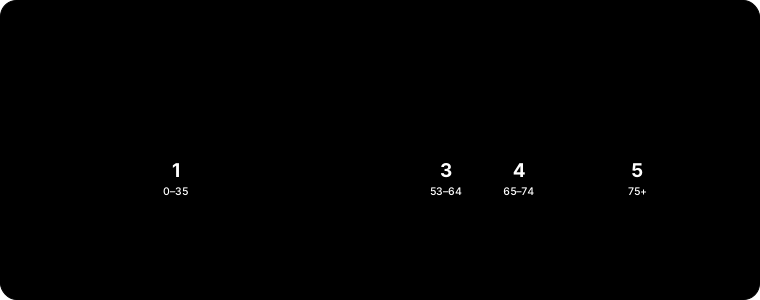
Once your composite is calculated, it maps onto the 1–5 scale using the estimated score cutoffs below: a composite of 75 or higher projects to a 5, 65–74 to a 4, 53–64 to a 3, 36–52 to a 2, and 0–35 to a 1. These thresholds are drawn from historical released curves and the shape of recent score distributions, but they are our estimates, not College Board figures.
Be clear about where the uncertainty actually lives. The 45/55 section weighting is official and exact, so the arithmetic above is not in dispute. What moves is (a) the raw-to-composite conversion, which College Board re-derives every year through statistical equating so that a 4 in one year means the same thing as a 4 in another, and (b) your own estimate of your essay scores. The second source of error is usually much larger than the first — students routinely award themselves the sophistication point that a trained reader would not have given. If you want a prediction you can trust, score your practice essays strictly, or hand them to your teacher and use their numbers in the AP Lit score calculator instead of your own.
College Board has never published the raw-score or composite cutoffs for AP English Literature, and it re-sets the conversion every year through equating. Anyone who claims to know the exact 2026 boundary for a 5 is guessing. Treat this prediction as a well-informed planning tool with a margin of a few composite points in either direction — and build in a buffer instead of aiming for the bare minimum.
What Is a Good AP Lit Score?
AP scores run from 1 to 5, and College Board attaches a qualification label to each: a 5 is "extremely well qualified," a 4 is "well qualified," a 3 is "qualified," a 2 is "possibly qualified," and a 1 carries "no recommendation." A score of 3 or higher is what people generally mean by a passing score, though "passing" is not an official term — a 3 simply means College Board considers you qualified to receive credit for an introductory college course.
In practice, "good" depends on what you want the score to do. If you are chasing college credit, a 4 or 5 clears almost every English placement policy, while a 3 is accepted at many public universities and rejected at most selective private ones. If you are using the score on an application, remember that admissions readers see it as one data point among many; a 4 in AP Lit alongside a strong English grade reads well. And if you are aiming to skip a required freshman composition or literature seminar, check the specific department policy — English credit varies far more between institutions than STEM credit does.
On a distribution basis, a 4 puts you in roughly the top 42% of AP Lit test-takers and a 5 in the top 16%. AP Lit is not an easy-5 exam: fewer than one student in six earns a 5, and the sophistication point in particular is awarded sparingly.

AP Lit vs AP Lang: Not the Same Exam
A surprising number of students land on an AP Literature calculator when they actually sat the other English exam, so it is worth spelling out. AP Lit (English Literature and Composition) is about literature: you analyze poetry, prose fiction, and drama, and you argue about how meaning is constructed through character, structure, narration, and figurative language. AP Lang (English Language and Composition) is about rhetoric and argument: you analyze non-fiction, synthesize sources, and build your own arguments.
The scoring architecture is similar — both use a 45/55 weighting and three essays on a 6-point rubric — but the question counts differ (AP Lit has 55 multiple-choice questions; AP Lang has 45) and the essay tasks are completely different. If you took the rhetoric-and-synthesis exam, use the AP Lang Score Calculator instead, because plugging Lang numbers into this tool will give you the wrong multiple-choice denominator.
AP Lit Score Distribution and Trends
The most recent official numbers were released by College Board on June 26, 2026. Among approximately 440,000 AP English Literature test-takers, 16% earned a 5, 26% earned a 4, 31% earned a 3, 16% earned a 2, and 11% earned a 1. That puts the pass rate (3 or higher) at 73%, and the distribution implies a mean score of about 3.20.
The picture is remarkably stable year over year. In 2025, 16.2% scored a 5, 26.9% a 4, 31.0% a 3, 15.9% a 2, and 10.0% a 1, for a pass rate of about 74% and an official mean of 3.23 across 416,531 test-takers. The 2026 cohort was roughly 6% larger and performed within about one percentage point at every score band — a sign that the four-answer-choice format introduced in 2025 did not meaningfully shift the curve, and that you should calibrate your expectations to these numbers rather than to pre-2025 data. You can check the official tables on the College Board score distributions page.
Read the distribution as a competitive benchmark, not a prophecy: the 3 band is the single largest group, and the gap between a 3 and a 4 is often just two or three rubric points spread across three essays.

| Year | % scoring 5 | % scoring 3+ | Test-takers |
|---|---|---|---|
| 2026 | 16% | 73% | ~440,000 |
| 2025 | 16.2% | 74.1% | 416,531 |
What-If Mode: Points You Need for a 3, 4, or 5
The best way to use this AP Lit score calculator is backwards: choose a target score, then find the combination of multiple-choice and essay points that gets you there. Because the two sections trade off against each other, there is no single answer — the table below shows one representative path to each score under the composite model, plus an essay-heavy route to a 5 for students whose strength is writing rather than timed reading.
Notice the last two rows. A student who answers 42 of 55 questions correctly needs 14 of 18 essay points for a 5, but a student who manages only 33 of 55 can still reach a 5 with 16 of 18 essay points. That is the practical consequence of the 55% free-response weight: on AP Lit, essays are the score.
| Goal score | MCQ (of 55) | Essay points (of 18) | Composite | Result |
|---|---|---|---|---|
| 3 | 30 | 10 | ~55.1 | 3 (needs 53+) |
| 4 | 36 | 12 | ~66.1 | 4 (needs 65+) |
| 5 | 42 | 14 | ~77.1 | 5 (needs 75+) |
| 5 (essay-heavy path) | 33 | 16 | ~75.9 | 5 (needs 75+) |
How to Get a 5 on AP Lit
Because the free-response section carries 55% of the weight and 18 discrete rubric points, the fastest route to a higher predicted score is almost always essay technique rather than more reading. The rubric is mechanical, and that is good news: 1 point for a defensible thesis is available to anyone who writes one arguable sentence, and 4 points for evidence and commentary reward explanation over quotation volume. Most students who plateau at a 3 are quoting adequately and explaining thinly.
On the multiple-choice side, drill in full five-passage sets against a 60-minute clock rather than doing loose practice questions. Timing is the real constraint: 55 questions in 60 minutes is roughly 65 seconds each, and poetry sets almost always run slower than prose. Because there is no guessing penalty and only four options per question since 2025, a blind guess is worth 0.25 questions on average — leaving anything blank is strictly worse than guessing.
For Q3, the Literary Argument, build an arsenal of three or four works you know at the level of specific scenes, character arcs, and structural turns. A shallow reference to a famous novel earns fewer commentary points than a precise reference to a play you actually studied. Then run the checklist below on every practice essay.
- Write a defensible thesis in your first two minutes — it is a guaranteed rubric point and it frames every paragraph after it
- Spend the bulk of each essay on commentary, since evidence and commentary is worth 4 of the 6 points
- Quote short and quote often: brief embedded quotations leave more room for explanation than block quotes
- Practice Q1 poetry under time — it is where most students lose the most points
- Prepare 3–4 works for Q3 in real depth: plot, character, structure, and at least two arguable themes
- Always attempt all three essays; an unwritten essay costs 6 of 18 points and about 18 composite points
- Answer every multiple-choice question — no guessing penalty, and only four choices since May 2025
- Drill multiple choice in full 5-passage sets under a 60-minute clock, mixing prose fiction and poetry
- Type your practice essays in a plain text box to mirror the digital Bluebook format
- Chase the sophistication point last, only once thesis, evidence, and commentary are consistently solid

The single biggest source of error in any AP Lit prediction is self-scored essays. Before you enter a 5, ask: is my thesis actually arguable? Does every quotation get at least two sentences of commentary tied back to the line of reasoning? Would a stranger call this sophisticated, or just long? If you are unsure, enter the lower number — a prediction that under-promises is far more useful for planning than one that flatters you.
When Do AP Lit Scores Come Out?
AP scores are released in early July each year, and 2026 scores went live on Monday, July 6, 2026. You view them by signing in at scores.collegeboard.org with the College Board account you used to register; the release typically rolls out by region over a few days rather than all at once, so a friend in another state seeing scores first is normal.
Once scores post, you can choose which colleges receive your score report and, if you want, withhold or cancel a score. Until release day, the AP Lit score calculator on this page is the fastest honest way to gauge where you probably landed — which is enough to decide whether to pre-register for a follow-on English course or plan a retake next May.
Explore More AP Score Calculators
Taking more than one exam this year? Predict every result with our full library of AP score calculators. If you doubled up on English, start with the AP Lang Score Calculator, then check the APUSH Score Calculator, the AP Psych Score Calculator, and the AP Stats Score Calculator — each uses the same transparent weighting method as this AP Lit calculator, with exam-specific section weights and cutoffs.
If your teacher curves in-class practice exams on a different scale, the Grade Curve Calculator will translate a raw classroom score into a letter grade, and longer strategy write-ups live on the blog.
Curious how AP English Literature's curve compares with other subjects? See our AP score curves compared across every exam, the easiest and hardest AP exams ranked by real pass rates, and the full AP score distributions for every exam.
Frequently Asked Questions
How accurate is the AP Lit score calculator?
The section weighting it uses (45% multiple choice, 55% free response) is official, so the arithmetic is exact. What is not official is the composite-to-score conversion: College Board has never published raw-score cutoffs for AP English Literature and re-derives them each year through statistical equating, so our 75 / 65 / 53 / 36 thresholds are transparent estimates you can edit. The larger error source is usually you — self-scored essays tend to run one to two rubric points high. Score your practice essays strictly, or use a teacher's marks, and the prediction typically lands within one AP score band.
Is this an AP Lit grade calculator or a score predictor?
Both, depending on what you need. As an AP Lit grade calculator it converts raw practice-test performance into a weighted composite out of 100, which is close to a percentage grade for classroom purposes. As a score predictor — the way most students use this AP English Lit calculator — it maps that composite onto the 1–5 AP scale. It does not calculate your course grade in your teacher's gradebook, since every school weights homework, essays, and tests differently.
What is a passing score on AP Lit?
A 3 or higher is what people call passing, though College Board's official language is "qualified" for a 3, "well qualified" for a 4, and "extremely well qualified" for a 5. In 2026, 73% of AP Lit test-takers scored a 3 or higher. Whether a 3 earns you college credit is a separate question — many public universities accept it, while selective private colleges often require a 4 or 5 for English placement.
What was the AP Lit score distribution in 2026?
College Board released the official numbers on June 26, 2026: 16% scored a 5, 26% scored a 4, 31% scored a 3, 16% scored a 2, and 11% scored a 1, across roughly 440,000 test-takers. That is a 73% pass rate and an implied mean of about 3.20. For comparison, 2025 produced 16.2% fives, 26.9% fours, 31.0% threes, 15.9% twos, and 10.0% ones, with a pass rate of about 74% and an official mean of 3.23.
How many multiple-choice questions can I miss and still get a 5?
There is no fixed number, because the essays carry 55% of the score. Under this AP literature calculator's model, 42 of 55 correct (13 missed) paired with 14 of 18 essay points reaches a composite of about 77 — a 5. But a student with only 33 of 55 correct (22 missed) still reaches a 5 with 16 of 18 essay points. Since there is no guessing penalty and each question has had four answer choices since May 2025, always fill in an answer.
Is the AP Lit exam curved?
Not in the classroom sense of ranking students against each other. College Board uses equating, a statistical process that adjusts for small differences in difficulty between exam forms so that a 4 always represents the same level of achievement from year to year. The practical effect looks like a curve — the composite needed for a 5 shifts a few points annually — which is exactly why the cutoffs in this tool are editable estimates rather than fixed numbers.
How are the three AP Lit essays scored?
Each essay is read by a trained reader and scored 0–6 on the same analytic rubric: 1 point for a defensible thesis, up to 4 points for evidence and commentary, and 1 point for sophistication of thought or style. The three tasks are Q1 Poetry Analysis, Q2 Prose Fiction or Drama Analysis, and Q3 Literary Argument, where you pick a work from a provided list or another novel or play of literary merit. Together they are worth 18 raw points and 55% of your exam score. All three are typed in Bluebook, not handwritten.
When do AP Lit scores come out?
In early July. The 2026 scores were released on Monday, July 6, 2026 at scores.collegeboard.org, and releases usually roll out by region across a few days rather than all at once. Sign in with the College Board account you used to register, then decide which colleges should receive your report.
What is the difference between AP Lit and AP Lang?
AP Lit (English Literature and Composition) is a literature exam — poetry, prose fiction, and drama analysis, with 55 multiple-choice questions and essays on poetry, prose, and a literary argument. AP Lang (English Language and Composition) is a rhetoric and argument exam — non-fiction analysis and source synthesis, with 45 multiple-choice questions and Synthesis, Rhetorical Analysis, and Argument essays. Both weight the sections 45/55 and use 6-point essay rubrics, but the multiple-choice totals differ, so use the calculator that matches the exam you actually sat.