The AP Physics 2 score calculator above turns your multiple-choice and free-response raw points into a weighted composite score out of 100 and a predicted 1–5 AP score. It is built on the current AP Physics 2: Algebra-Based exam — 42 multiple-choice questions worth 50% and 4 free-response questions (40 points) worth the other 50%, the format College Board lists for May 2027. Below: the exact formula with worked arithmetic, our clearly labeled estimated cutoffs and how we derived them, the official 2025 and 2026 score distributions, and the raw points you need for a 3, 4 or 5.
How the AP Physics 2 Score Calculator Works
The calculator mirrors the real exam’s two-section design with no hidden adjustments. You enter how many of the 42 multiple-choice questions you answered correctly and how many points you earned on each of the four free-response questions (worth 10, 12, 10 and 8 points). Each section is scaled to 50, the two halves are added into a composite out of 100, and that composite is compared against estimated cutoffs to produce a predicted 1–5.
Because College Board never publishes the raw-to-scaled conversion for a given administration, this AP Physics 2 score predictor is a model, not an official readout. It is most useful for answering practical questions: Am I safely inside the 4 band or one free-response part away from a 3? Is my time better spent on multiple choice or on the experimental-design question? Enter real practice-test numbers and the answer appears instantly.

| Question | Section | Max | Weight |
|---|---|---|---|
| Multiple Choice Correct | Multiple Choice | 42 | |
| Q1: Mathematical Routines | Free Response | 10 | |
| Q2: Translation Between Representations | Free Response | 12 | |
| Q3: Experimental Design and Analysis | Free Response | 10 | |
| Q4: Qualitative/Quantitative Translation | Free Response | 8 |
Inputs: multiple-choice questions correct (0–42) and free-response points for Q1 (0–10), Q2 (0–12), Q3 (0–10) and Q4 (0–8). Outputs: a weighted composite on a 0–100 scale, a predicted AP score of 1–5, and how far you sit from the next band. Wrong and blank multiple-choice answers cost nothing, so count only the questions you got right.
How the AP Physics 2 Exam Is Scored
AP Physics 2: Algebra-Based is the second-semester, algebra-based college physics course. Its redesigned framework took effect with the May 2025 exam, renumbering the content as Units 9–15 so it continues directly from AP Physics 1’s Units 1–8 (fluids now lives in AP Physics 1). Per the official College Board exam page, the test is a hybrid digital exam: you answer multiple choice in the Bluebook app and handwrite free-response answers in a paper booklet.
Section I is multiple choice and counts for 50% of your score. Section II has four free-response questions, also 50%, totaling 40 raw points: Q1 Mathematical Routines (10 points), Q2 Translation Between Representations (12 points), Q3 Experimental Design and Analysis (10 points) and Q4 Qualitative/Quantitative Translation (8 points). A four-function, scientific or graphing calculator is allowed on both sections, and a table of equations is provided.
What changed for May 2027: College Board’s course and exam description clarifications raise multiple choice from 40 questions in 80 minutes to 42 questions in 85 minutes, and trim free response from 100 to 95 minutes. The total is still 3 hours and the 50/50 weighting and FRQ point values are unchanged. The May 2025 and May 2026 exams used the 40-question format, so many practice tests still have 40 multiple-choice items — see the conversion tip below.
| Section | May 2027 format | May 2025–2026 format | Weight | Raw points |
|---|---|---|---|---|
| I: Multiple Choice | 42 questions, 85 min | 40 questions, 80 min | 50% | 42 (40 on older forms) |
| II: Free Response | 4 questions, 95 min | 4 questions, 100 min | 50% | 40 (10 + 12 + 10 + 8) |
| Total | 46 items, 180 min | 44 items, 180 min | 100% | 82 (80 on older forms) |
Because each section is scaled to a percentage, you can convert an older 40-question multiple-choice score before entering it: multiply by 1.05 and round. For example, 30 of 40 correct becomes about 31–32 of 42. Your composite comes out the same either way, because 75% of the multiple-choice section is worth 37.5 composite points on both forms.
The Composite Score Formula, Shown Transparently
Since both sections carry equal weight, each multiple-choice question is worth about 1.19 composite points (50 ÷ 42) and each free-response point is worth exactly 1.25 composite points (50 ÷ 40). The formula is:
Composite = (MCQ correct ÷ 42) × 50 + (FRQ points ÷ 40) × 50
Worked example: Suppose you get 30 of 42 multiple-choice questions right and earn 27 of 40 free-response points. Your multiple-choice contribution is (30 ÷ 42) × 50 = 35.7 and your free-response contribution is (27 ÷ 40) × 50 = 33.75, for a composite of 69.5 — a predicted 4 (62–75). Push your free response to 32 points and the composite reaches 75.7, still a 4 by a fraction of a point; one more point, 33 of 40, lifts it to 77.0 and a predicted 5. That is why a single rubric point on an FRQ can matter as much as an extra multiple-choice question.
| Question | Type | Max points | 2025 mean | Mean as % of max |
|---|---|---|---|---|
| Q1 | Mathematical Routines | 10 | 5.32 | 53% |
| Q2 | Translation Between Representations | 12 | 8.12 | 68% |
| Q3 | Experimental Design and Analysis | 10 | 7.22 | 72% |
| Q4 | Qualitative/Quantitative Translation | 8 | 5.42 | 68% |
| Total | Section II | 40 | 26.08 | 65% |
What the 2025 free-response data tells you
Mathematical Routines was the lowest-scoring question in 2025, with students averaging just over half the available points, while Experimental Design and Analysis — often feared — was the highest at 72%. The typical student earned about 26 of 40 FRQ points, worth roughly 32.6 composite points. If your practice FRQ totals sit well below 26, Section II is probably where your fastest gains are.
College Board does not release the exact raw-score-to-1–5 conversion for any AP Physics 2 administration. The cutoffs below are EduCalcDb estimates derived from official score distributions and scoring statistics, and the real thresholds shift slightly every year through equating. Treat the predicted score as guidance, not a guarantee.
AP Physics 2 Score Cutoffs (Estimated)
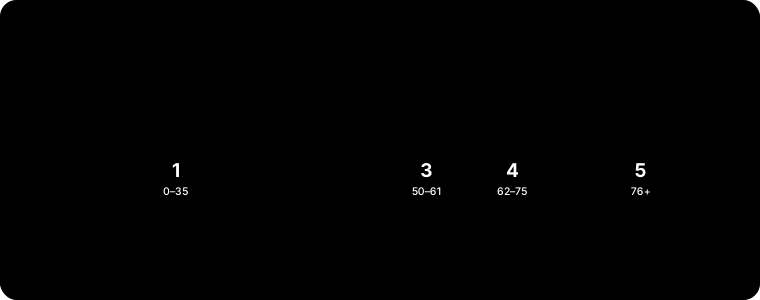
This calculator uses these estimated composite score cutoffs out of 100: 76+ for a 5, 62–75 for a 4, 50–61 for a 3, 36–49 for a 2, and 0–35 for a 1.
How we estimated them: the only raw-score data College Board publishes for the redesigned exam is the free-response scoring statistics. In 2025, AP Physics 2 students averaged 26.1 of 40 FRQ points (65%), compared with 20.4 of 40 (51%) on AP Physics 1 that same year — yet Physics 2’s pass rate (72.6%) was only about five points higher than Physics 1’s (67.3%). Students performing that much better on raw points while earning only slightly more 3s implies the raw bar for each score sits higher on Physics 2 than on Physics 1. We placed each cutoff where it would reproduce the official 2025 distribution (72.6% scoring 3+, 50.6% scoring 4+, 21.8% scoring 5) under the assumption that multiple-choice performance tracks free-response performance, then rounded conservatively. Some other calculators use lower, Physics 1-style cutoffs for Physics 2; we think that likely overstates scores, so we would rather you aim a little high.
AP exams are equated so a 4 means the same thing every year even when one form is harder. That means the real raw threshold can drift a few points between administrations — and our estimates carry extra uncertainty because multiple-choice statistics are not published. If your composite is within about 3 points of a cutoff, treat the result as a coin flip and study to clear the band comfortably.
What Is a Good AP Physics 2 Score?
AP scores run from 1 to 5. College Board describes a 3 as “qualified,” a 4 as “well qualified” and a 5 as “extremely well qualified.” A 3 or higher is what students usually mean by passing, though that is not an official term — the accurate framing is that a 3+ can make you eligible for college credit or placement, depending on the school.
Because AP Physics 2 is equivalent to the second semester of algebra-based college physics, the credit it earns usually replaces a second-semester introductory physics course — useful for pre-health, life-science and many non-engineering majors. Engineering and physics programs typically expect calculus-based physics instead, which is where AP Physics C: E&M comes in. Always check the credit policy of each college on your list; some require a 4 or 5.
AP Physics 2 Score Distribution and Trends
AP Physics 2 has one of the stronger score profiles among the AP sciences, largely because most students take it after already completing AP Physics 1. According to the official College Board score distributions, 72% of students scored 3 or higher in 2026: 20% earned a 5, 29% a 4, 23% a 3, 21% a 2 and 7% a 1. That closely tracks 2025, the first year of the redesigned exam, when 72.6% scored 3+ across 24,211 test-takers with a mean score of 3.38.
The redesign’s clearest effect was on the 4s. In 2024, under the old framework, 18.0% of students earned a 4 and 33.4% a 3; in 2025 those shares flipped to 28.8% and 22.0%. Pass rates edged up only modestly, but far more students moved from a 3 into the 4 band.

| Year | 5 | 4 | 3 | 2 | 1 | % scoring 3+ | Mean |
|---|---|---|---|---|---|---|---|
| 2026 | 20% | 29% | 23% | 21% | 7% | 72% | ≈ 3.34 |
| 2025 | 21.8% | 28.8% | 22.0% | 20.2% | 7.2% | 72.6% | 3.38 |
| 2024 | 19.1% | 18.0% | 33.4% | 22.9% | 6.6% | 70.5% | 3.20 |
| 2023 | 16.5% | 18.5% | 34.9% | 23.8% | 6.4% | 69.8% | 3.15 |
What-If Mode: Points You Need to Reach Your Target Score
Working backward from a target is the fastest way to plan your prep. The table assumes you perform at about the same level on both sections; because the sections are weighted equally, you can trade roughly one multiple-choice question for one free-response point and stay at the same composite. Plug your own split into the calculator to fine-tune.
| Goal score | MCQ correct (of 42) | FRQ points (of 40) | Composite |
|---|---|---|---|
| 5 | 32 | 31 | ≈ 76.9 |
| 4 | 26 | 25 | ≈ 62.2 |
| 3 | 21 | 20 | 50.0 |
| 2 | 15 | 15 | ≈ 36.6 |
How to Get a 5 on AP Physics 2
A 5 on AP Physics 2 requires about three-quarters of all available points, so you cannot coast on a strong unit or two. Start with Mathematical Routines, the lowest-scoring FRQ in 2025: practice deriving symbolic expressions that begin from a fundamental principle or an equation from the reference table, exactly as the rubric asks, and carry units and directions through every step. For Translation Between Representations, rehearse moving between circuit diagrams, field-line sketches, ray diagrams and graphs, then writing the equation the picture implies.
On Experimental Design and Analysis, name what you will measure and with which equipment, describe a repeatable procedure, and explain how you would linearize the data and pull a quantity from the slope. For Qualitative/Quantitative Translation, pair a clear physical argument in words with the supporting math — the rubric rewards conceptual reasoning, not algebra alone. On multiple choice you have roughly two minutes per question, so do not let a single question set swallow ten minutes.
Content-wise, the three highest-weighted units — thermodynamics, electric force/field/potential, and electric circuits — each account for 15–18% of the exam, so together they make up roughly half of it. Weak spots in those three units cost more than gaps anywhere else.
- Unit 9: Thermodynamics (15–18%)
- Unit 10: Electric Force, Field, and Potential (15–18%)
- Unit 11: Electric Circuits (15–18%)
- Unit 12: Magnetism and Electromagnetism (12–15%)
- Unit 13: Geometric Optics (12–15%)
- Unit 14: Waves, Sound, and Physical Optics (12–15%)
- Unit 15: Modern Physics (12–15%)
AP Physics 2 vs. AP Physics 1 and AP Physics C
All four AP Physics exams now share the same free-response blueprint — Mathematical Routines, Translation Between Representations, Experimental Design and Analysis, and Qualitative/Quantitative Translation, worth 10, 12, 10 and 8 points — and all split the score 50/50 between multiple choice and free response. What differs is content, math level and the curve. Physics 1 and 2 are algebra-based and together form a full year of introductory college physics; Physics C: Mechanics and Physics C: E&M are calculus-based and are each equivalent to one semester.
If you are deciding between Physics 2 and Physics C: E&M, the overlap is real: both cover electric fields, potential, circuits and magnetism, but E&M adds calculus and drops thermodynamics, optics and modern physics.
Estimate any of them with the matching tool: the AP Physics 1 score calculator, the AP Physics C Mechanics score calculator or the AP Physics C E&M score calculator.
| Exam | Math level | Core content | 2026 % scoring 3+ |
|---|---|---|---|
| AP Physics 1 | Algebra-based | Mechanics, rotation, oscillations, fluids | 68% |
| AP Physics 2 | Algebra-based | Thermodynamics, E&M, optics, waves, modern physics | 72% |
| AP Physics C: Mechanics | Calculus-based | Mechanics with calculus | 72% |
| AP Physics C: E&M | Calculus-based | Electricity and magnetism with calculus | 75% |
How Accurate Is This AP Physics 2 Score Calculator?
The structure of the calculation is exact: the 50/50 section weighting, the 42-question multiple-choice section and the 10/12/10/8 free-response point values all come straight from College Board. The weak link — for every AP score predictor — is the cutoffs, which are never published. Ours are derived from the official 2025 distribution and free-response statistics, but multiple-choice performance data is not released, so a predicted score within a few points of a boundary could go either way.
The calculator is most accurate when you feed it honest inputs: a full, timed practice exam scored with the official rubrics. Released free-response questions and scoring guidelines are on AP Central; grade yourself strictly, since rubric points require the specific reasoning described, not just a correct final answer. For how scores are set and reported, see College Board’s About AP Scores.
When Is the AP Physics 2 Exam, and When Do Scores Come Out?
College Board lists the 2027 AP Physics 2 exam for Thursday, May 6, 2027. AP scores are released online in July of the testing year, in your College Board account. Until then, this AP Physics 2 score calculator is the best way to estimate where you landed based on your practice exams and the released free-response questions.
Explore More AP Score Calculators
Need a different AP Physics score calculator? Estimate the algebra-based first course with the AP Physics 1 Score Calculator, or the calculus-based exams with the AP Physics C Mechanics Score Calculator and the AP Physics C E&M Score Calculator.
Taking several AP exams? Predict every score with our full set of AP score calculators, including the AP Chemistry Score Calculator and the AP Calc AB Score Calculator. To see how AP Physics 2 compares with every other subject, read our AP score distributions for every exam and AP score curves compared.
Frequently Asked Questions
Is this AP Physics 2 score calculator accurate?
It is an accurate directional estimate. The 50/50 weighting between the 42-question multiple-choice section and the 40-point, four-question free-response section is official, but the composite cutoffs are EduCalcDb estimates because College Board never publishes the raw-to-scaled conversion. Treat any result within about 3 composite points of a cutoff as borderline.
How does the AP Physics 2 curve convert raw points to a 1–5?
Your multiple-choice and free-response points are each scaled to 50 and added into a composite out of 100. This calculator then applies estimated cutoffs: about 76+ for a 5, 62–75 for a 4, 50–61 for a 3 and 36–49 for a 2. Real cutoffs are not published and shift slightly each year through equating.
What is the format of the AP Physics 2 exam?
Starting with the May 2027 exam, Section I has 42 multiple-choice questions in 85 minutes (50%) and Section II has 4 free-response questions in 95 minutes (50%), worth 40 points: Mathematical Routines (10), Translation Between Representations (12), Experimental Design and Analysis (10) and Qualitative/Quantitative Translation (8). The 2025 and 2026 exams used 40 multiple-choice questions in 80 minutes and 100 minutes of free response. Calculators are allowed on both sections.
What score do I need to pass AP Physics 2?
A 3 or higher is considered qualified, the usual meaning of passing. Using our estimated cutoffs, a 3 needs a composite of about 50 out of 100 — for example, 21 of 42 multiple-choice questions and 20 of 40 free-response points.
What was the 2026 AP Physics 2 score distribution?
Per College Board, 20% of 2026 test-takers earned a 5, 29% a 4, 23% a 3, 21% a 2 and 7% a 1, so 72% scored 3 or higher. In 2025, 72.6% scored 3+ with a mean score of 3.38 across 24,211 students.
How many questions can I miss and still get a 5 on AP Physics 2?
With our estimated cutoff of 76, scoring about 32 of 42 on multiple choice and 31 of 40 on free response just clears a 5. That means missing roughly 10 multiple-choice questions and 9 free-response points. Because the sections are weighted equally, a stronger FRQ performance lets you miss more multiple-choice questions, and vice versa.
Can I use this calculator with a 40-question practice test?
Yes. Multiply your 40-question multiple-choice score by 1.05 and round to the nearest whole number before entering it — 30 of 40 becomes about 31–32 of 42. Each section is scaled to a percentage, so the composite comes out the same.
Is AP Physics 2 harder than AP Physics 1?
The content is broader — thermodynamics, electricity and magnetism, optics, waves and modern physics — but pass rates are higher: 72% scored 3+ on Physics 2 in 2026 versus 68% on Physics 1. That largely reflects who takes it: most Physics 2 students have already completed Physics 1. In 2025 they also averaged more free-response points (26.1 of 40 vs. 20.4), which is why our estimated raw cutoffs for Physics 2 are higher.
When are AP Physics 2 scores released?
AP scores come out online in July of the testing year, in your College Board account. The 2027 AP Physics 2 exam is scheduled for Thursday, May 6, 2027.